All Movement, No Strategy
By Brandon Jones & Jean Paul Mella
The Party and the Movement
In the past two centuries, history has recorded a number of working class movements and uprisings, from the continent-sweeping European Revolutions in 1848 to the trade union movement in twenty-first century India. Alongside the workers, the intermediate sections of society have also been a crucial world-historical factor. These sections of society participated in the decolonization struggles, the fight for democratic rights in the US, women's liberation, the anti-caste movement, free public transportation protests, anti-corruption movements and a number of other instances of popular struggle which were not consciously aimed at total systematic change. Under the capitalist political-economic system, struggles against the social consequences of the system will persist. Capital's insatiable hunger for profit leads it to repress the workers, to turn every bit of social life into a commodity.
Owing to its position in the process of capitalist production, the working class is the revolutionary agent of our time. The workers' historic mission is to defeat the capitalists in the contest for power and construct socialism-communism. To accomplish this, a vanguard communist party is needed to lead the class in the struggle and strike at the decisive moment. However, the communist party is no silver-bullet for the victory of the socialist revolution. In the dynamism of the class struggle, other elements need to be considered. While the party is the decisive factor, without which the workers are at the mercy of capital, the party alone does not guarantee victory. The mass movement is an essential component of the class struggle. There must exist unity between the party and the mass movement.
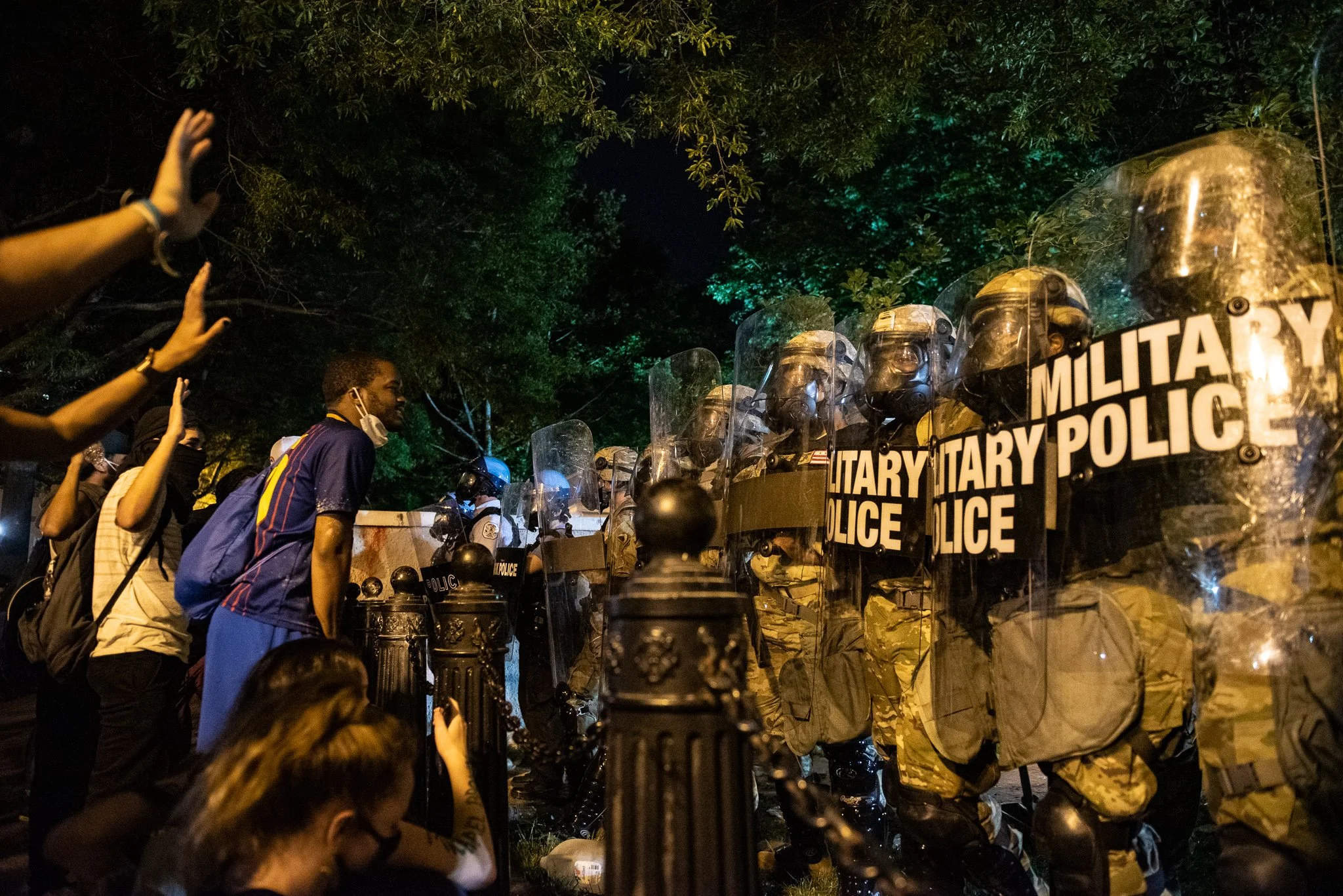
We see today in the United States a litany of mass movements springing up from decades and more of popular action. BLM, Palestine, and general Anti-Trump movements (including mobilizations against ICE raids) have all put hundreds of thousands of people on the streets in recent years. However, a concentrated struggle against the capitalist system itself has yet to develop out of these movements, due to the glaring absence of a revolutionary communist party. All these mass movements have emerged spontaneously and with no coherent strategy. It is the responsibility then, of the communists to imbue these movements with a class content and an overarching revolutionary strategy. The consequences for failure on this front are grave.
The Movements
The Black Lives Matter movement started on July 13, 2013, by activists protesting the numerous murders of Black Americans by police brutality, including Trayvon Martin, Michael Brown, and Eric Garner. It's a decentralized movement, without any clear structure or leadership, advocating for reforming the capitalist system to be a safer place for Black Americans.
Following October 7 and the subsequent genocide in Gaza, the Free Palestine movement erupted with nationwide protests after the start of Israel's assault. There were protests in many major US cities garnering crowds of millions. These protests became popular on university campuses and have led to the arrest of over 3,100 protesters. This movement is organized by dozens of anti-war groups like Answer Coalition, all advocating for ending the genocide in Gaza and stopping the US from sending aid to Israel.
There have been two largely anti-Trump movements that have started this past year. First, the No Kings movement, started in June 2025 to oppose Donald Trump’s presidency and his authoritarian policies. In June they had crowds of five million people attend these protests, while in October they had seven million. These protests were organized by a coalition of over 200 groups, including Indivisible and 50501. The vast majority of these groups support reforming capitalism and believe the solution to the rise of fascism is through electing democratic party candidates. Second, the Anti-ICE protests, started in January 20205 to oppose the Trump administration's harsh policies of abducting people and deporting them without a trial. As ICE raids continue to happen all over the country, there has been consistent demonstrations all over to oppose these cruel policies. These protests are formed mostly by progressive pro democrat party groups like Indivisible, who believe the solution is to reform, not abolish, ICE, and to vote in a democratic president.
Where Is the Strategy?
The Democratic Party is where movements go to die. As a capitalist party, it plays a central role in the current system, intercepting progressive movements, sapping them of all their revolutionary character, and vaguely incorporating them into liberal messaging, mostly in words and not with actions. This has happened time and time again. With BLM for example, despite now twelve years of protesting, organizing, and their becoming popular within the Democratic Party, there has been no meaningful change. The police killings of Black Americans is mostly the same year after year, there has been no meaningful police reform nationwide. The Democrats will claim they can’t make sweeping changes due to not having enough power in congress, but this is by design. The Democratic Party serves as a representative of one wing of billionaires against another. Democrats serve capital just as the Republicans do, and they have no intention of making sweeping changes just to gain support for elections. It’s the same cycle over and over again: advocate for progressive policies, get elected, feign powerlessness for 4-8 years, lose to Republicans, advocate for progressive policies again and sprinkle in a few slogans like “this is the most important election of our lives.”
So, we know the Democrats won’t bring any meaningful change, but why? The answer lies in the fact that capitalism itself is the root cause of all the problems these mass movements have emerged from, and the Democratic Party supports that very capitalist system. Capital requires an oppressive, brutal police force to keep capitalism functioning and to suppress the organization of working class people around the country. Attacks on migrant workers serve to manipulate the working class into believing their lives are getting worse due to a foreign enemy, while the ultra-rich capitalists hoard masses of wealth by exploiting both migrant and non-migrant workers. The only way to put an end to this oppressive police state and to end ICE raids is to end capitalism. The real solution is socialism, where the exploitation of labor is abolished and the workers own the means of production and have real power in the government.
Knowing that the solution is socialism, not reform, begs the critical question: how do we achieve it? The answer lies in the essential element these disparate movements lack: a revolutionary strategy. This requires a conscious organization, serving as the leading center guiding these movements towards the overthrow of capitalism itself. The existing movements have largely been steered by reformist groups that either willingly tail the Democratic Party or sell their souls to its apparatus, never targeting the root cause itself. The objective effect is to prop up the “left” wing of the capitalist dictatorship. This losing strategy saps these movements of their revolutionary potential, leading them to political dead ends.
The Revolutionary Situation and the Need to Unite the Workers and the Movement
The class struggle between the workers and capitalists is constant. High prices for food and rent, low wages, and immigration raids. This is the capitalist class in battle with the workers. While the class struggle is constant, the decisive moment when the earth shakes and the scales tip just right for the power of the ruling class to waver and that of the revolutionary class to consolidate is a rare and specific moment. This is an objective set of circumstances, a revolutionary situation. It is at this moment that the exploited class has a small window of opportunity to strike the definitive blow and take power. These moments in the class struggle are few and far between, scattered over decades or generations and usually coming about as the result of major systemic shocks, such as war or economic crisis (or both). Russia in 1917, Germany in 1918, Cuba in the 1950s, China in the 1920s through 40s, Vietnam in 1945, and Iran in 1979 are just a few examples in recent history.
Arguably, a number of revolutionary situations existed in the 2010s, notably in the Arab Spring uprisings sparked in Tunisia and spreading to Egypt and beyond. Mass movements that had existed prior or sprung up in the moment then exercised considerable strength, to the extent that the Ben Ali government in Tunisia and the Mubarak government in Egypt were both overthrown. A number of other mass movements rocked the world in the past decade in the US and beyond, such as in Hong Kong, Brazil, and Sudan. In all cases in the 2010s, one through-line stuck out: the absence of a vanguard communist party to connect the upsurge of popular discontent with the struggle of the working class for power. Further, the purported communist parties that existed in those countries at the time had by and large abandoned the class struggle for decades. The result was that each mass movement won minor gains at best, as in Chile, paved the way for a reactionary turn, as in Brazil and Egypt, or, most horrifyingly, left the door open to military rule that devolved into a brutal civil war, as in Sudan. Tragically, for the workers who heroically involved themselves in these upheavals, each moment proved to be all movement and no strategy for power.
In the United States, as in the other countries, what we see is a wide array of mass movements bubbling up to varying degrees of intensity. In the summer of 2025, anti-ICE protests erupted into street clashes between protesters and police in Los Angeles. In Chicago, a network of Migra Watch activists emerged to harass ICE's Operation Midway Blitz throughout the late summer and fall. The No Kings rallies drew millions of Americans into the streets in June and October voicing opposition to Trump's policies. The mass movements are alive and thriving in the USA, but as of yet there exists no strategy for working class power. Absent such a strategy, these movements will continue to be at the mercy of wavering tendencies, subject to the momentary ebbs and flow of popular discontent. This ultimately leaves the workers vulnerable to the dictatorship of capital. The workers of the USA must learn from the mistakes and successes of past and current events. There is a need for the elaboration of revolutionary strategy to unite the mass movements with a revolutionary working class program for power.
It is critical to note that a communist party divorced from the mass movements and working class is equally dangerous. Che Guevara and the Ñancahuazú Guerrillas in Bolivia learned this harsh lesson with the failure and isolation of the movement there. The Weather Underground is a notable home-grown example of a purported revolutionary organization with no organic connections to the workers or mass movements. The party and the movement evolve in tandem, but not automatically or spontaneously. Communists must actively cultivate connections with the mass movements to imbue them with class-struggle content while also building the communist party itself and its firm roots in the working class.
The Communist Workers' Platform USA, aiming to build the communist party the working class needs, will work to develop the link between the working class and the mass movements, orienting the struggle in the contest for power with the development of our revolutionary program.