
Behind the electoral contest between Democrats and Republicans in the United States, a deep conflict of corporate interests is unfolding, cutting across both parties' political apparatuses. Different sections of capital are competing for a larger share of government spending, tax breaks, protection from international competition, and more favorable conditions for expanding their investments.
This situation is reflected in a series of open fronts of conflict, only some of which we outline below. These contradictions are connected to the broader effort by the United States to maintain its economic, technological, and military primacy in competition with China, amid intensifying international competition and the restructuring of global supply chains.
Record-Breaking Corporate Contributions to the Elections
One indication of the intensity of contradictions within the capitalist class, and how these are expressed in political confrontation in the United States, was the record amount of money that corporate groups funneled to their favored politicians to advance their interests.
According to an analysis by the organization Public Citizen, corporate political spending in the 2026 federal elections had reached $737.3 million. This figure was 60% higher than the $461 million that corporations had spent throughout the entire 2024 election cycle, when presidential elections were held.
These figures represent recorded corporate contributions through October 23 and do not include every form of political financing, as substantial sums are also channeled through organizations that are not required to disclose their donors.¹
The sources of this money are particularly revealing. Cryptocurrency companies had contributed $233 million, online gambling businesses $85.2 million, and technology and artificial intelligence corporations $73.1 million. Together, these three sectors accounted for more than half of all recorded corporate contributions. Fossil fuel corporations also played a significant role, with total spending of $51.4 million.
According to the data, corporate groups are not investing exclusively in one political camp. Instead, they are establishing multiple channels of political influence, seeking to shape legislation and government decisions regardless of which party holds the congressional majority.
Seeking New Routes to Government Coffers
A characteristic example is the confrontation unfolding within the American "defense" industry. The traditional giants Lockheed Martin, RTX, Northrop Grumman, General Dynamics, and Boeing, which have dominated military procurement for decades, are facing the growing strength of a new generation of technology companies, such as Anduril, Palantir, and Shield AI.
These newer companies are competing for a substantial share of enormous military expenditures by capitalizing on advances in unmanned systems, artificial intelligence, autonomous weapons systems, and digital infrastructure for military operations.
The Trump administration is promoting changes to the Pentagon's procurement system, aimed at accelerating procedures and making greater use of commercially available technologies. This shift creates new opportunities for companies that, until recently, did not have the same access to major defense procurement programs.
Both sides maintain powerful political connections. Defense industry corporations had contributed nearly $5 million to members of Congress from both parties, including lawmakers serving on committees responsible for military procurement decisions.²
Pharmaceutical Companies Versus Insurers
Another front lies in the pharmaceutical market, where the confrontation between drug manufacturers and pharmacy benefit managers is intensifying.
On one side are giants such as Pfizer, Merck, Eli Lilly, and Johnson & Johnson, principally represented by the trade association PhRMA. On the other are Pharmacy Benefit Managers (PBMs), such as CVS Caremark, Express Scripts, and Optum Rx, which administer prescription drug benefits on behalf of insurance companies and employers. The three largest PBMs control approximately 80% of the prescription drug market in the United States.
Pharmaceutical companies accuse PBMs of exploiting their powerful market position to extract discounts and rebates, influencing final drug prices and the terms under which medicines are made available. PBMs, for their part, maintain that their bargaining power supposedly helps keep costs down for insurance plans.³
The confrontation reached Congress in February 2026, when regulations governing PBMs were approved, addressing the return of rebates to employer-sponsored insurance plans and changes to how PBMs are compensated. PhRMA welcomed the changes, while the association representing PBMs opposed them, arguing that the new regulations favor pharmaceutical companies. In June, the association even launched a multimillion-dollar advertising campaign to defend the role of its member companies.
The conflict is also reflected in political lobbying expenditures. PhRMA spent $37.9 million on lobbyists in 2025, while during the first three quarters of 2026 it contributed at least $130,000 to Republicans and $107,500 to Democrats and their political organizations.⁴
Between Electric Vehicles and "Protectionism"
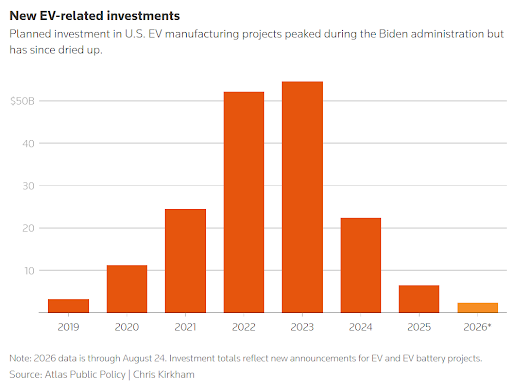
The contradictions within the automotive industry are similarly complex. The Trump administration's policies of eliminating tax incentives for purchasing electric vehicles, relaxing environmental standards, and imposing tariffs on components and raw materials are creating problems for corporate groups that had invested in electric vehicles and battery production.
According to a Reuters investigation in September 2026, canceled investment plans in the electric vehicle and battery sectors amounted to nearly $20 billion in 2025 alone. Approximately 80% of the canceled investments were located in Republican-controlled states.⁵
Meanwhile, traditional automakers face a different set of problems. General Motors and Ford, like other major manufacturers, depend on international production chains and imported components. Tariffs increase their costs, while uncertainty over the future of trade agreements with Canada and Mexico makes it difficult to plan their investments.
Thus, in September, the Alliance for Automotive Innovation, which represents GM, Ford, Toyota, Volkswagen, Hyundai, Stellantis, and other manufacturers, called on Congress to enact a permanent ban on the importation of Chinese automobiles and their associated technologies into the United States. It is worth recalling that Trump had previously left open the possibility of Chinese automakers establishing operations in the country, "provided they build factories and create jobs."
Importers Versus Domestic Producers
Another front concerns trade policy, where the Trump administration's efforts to impose tariffs on imports have generated conflicts with major American businesses. Retail chains and manufacturers that depend on imports argue that tariffs increase production costs.
On February 20, the National Retail Federation, which represents the retail industry, welcomed the US Supreme Court's decision striking down the tariffs Trump had imposed under the International Emergency Economic Powers Act (IEEPA). It also called for importers to be refunded the amounts they had paid.
Thus, while the White House presents tariffs as a means of strengthening domestic production in the trade war, itself an element of escalating imperialist rivalries, major corporate groups are demanding exemptions for products they cannot obtain competitively from the American market.
Corporate spending on hiring lobbyists and exerting political pressure specifically over tariff-related issues reached $9.9 million in the second quarter of the year, compared with just $1.3 million during the corresponding period in 2024. These groups are pushing for the elimination of tariffs, additional exemptions for specific products, and protection from foreign competition.⁶
The Dispute Over the Cost of Artificial Intelligence
The expansion of artificial intelligence is opening up a new arena of conflict. Operating enormous data centers requires ever-increasing quantities of electricity, driving billions of dollars in investment in new power plants, transmission networks, and infrastructure. The central question now is who will bear the cost of these investments and to what extent that cost will be passed on to other consumers through electricity bills.
A characteristic example is Texas, where the expansion of data centers has created a new market for oil and natural gas companies. In September 2026, the now-former governor of Texas, Greg Abbott, ordered a suspension of new permits for data centers pending the completion of an assessment of their impacts.
This followed a freeze on new grid connections, as applications from large electricity consumers exceeded 470 gigawatts, a figure many times greater than the state's peak demand. The state government required companies to cover the costs of the electricity grid infrastructure they needed themselves, rather than passing those costs on to other consumers.
While the government and corporate groups promote artificial intelligence as a critical area for maintaining American technological primacy, its development is intensifying competition over energy and infrastructure. Technology giants are seeking cheap, reliable electricity supplies, energy corporations are pursuing new opportunities for profit, and electric utilities are pressing for investment in the grid, with the question of how the costs will be distributed remaining unresolved.⁷
Oil Companies Versus Agribusiness Interests
Another front concerns biofuel policy, where the interests of oil refineries clash with those of agribusiness corporations producing corn and soybeans, as well as ethanol and biodiesel producers.
US law requires refineries to blend specified quantities of biofuels into gasoline and diesel or purchase renewable fuel credits from companies that produce them. Oil companies seek to limit these obligations because they impose additional costs, while agricultural businesses and biofuel producers defend the quotas that guarantee demand for their raw materials.
The confrontation intensified in August 2026, when the White House pressured the Environmental Protection Agency (EPA) to grant more exemptions to small refineries from biofuel blending requirements, citing the need to keep fuel prices down.
Organizations representing large-scale farmers and ethanol producers reacted by warning that the exemptions would reduce demand for corn and soybean oil. The American Soybean Association estimated that the policy could eliminate demand for 500 million gallons of renewable fuel and cause $1 billion in losses for soybean producers.
On August 31, the EPA ultimately approved exemptions corresponding to 1.76 billion renewable fuel credits for the 2025 compliance year, nearly twice the number initially expected. The decision came as a result of intense pressure from both refineries and agricultural organizations.⁸
The Battle Over Credit Card Fees
Another conflict concerns credit card transaction fees. The major banks, along with Visa and Mastercard, which defend the existing fee structure, find themselves opposed by large retail chains, supermarkets, and gas stations.
The size of the market is revealing. According to figures cited by the Merchants Payments Coalition, total credit and debit card transaction fees in the United States reached $198.25 billion in 2025. Meanwhile, the Federal Reserve Bank of St. Louis estimated that American banks collected nearly $66 billion in transaction fees during the same year.
Large Merchants are pressing for the passage of the Credit Card Competition Act, which would require banks with assets exceeding $100 billion to allow transactions to be processed through at least one alternative network, in addition to those operated by Visa and Mastercard.
The confrontation also has a legal dimension. In June 2026, a federal judge granted preliminary approval to a revised $38 billion settlement between Visa, Mastercard, and merchants, following years of litigation over transaction fees.⁹
Sources:
1. Corporate Political Spending Hits 737 Million dollars in 2026 Midterms, 60% Higher Than 2024 Presidential Election, https://www.citizen.org/news/corporate-political-spending-hits-737-million-in-2026-midterms-60-higher-than-2024-presidential-election/
2. Military Times, Defense contractors have donated millions to members of Congress, new report finds, https://www.militarytimes.com/news/pentagon-congress/2026/05/12/defense-contractors-have-donated-millions-to-members-of-congress-new-report-finds/
3. What to Know About Pharmacy Benefit Managers and Federal Efforts at Regulation, https://www.kff.org/other-health/what-to-know-about-pharmacy-benefit-managers-pbms-and-federal-efforts-at-regulation/
4. Bloomberg Law, PhRMA Plays Both Sides of the Aisle in Midterm Election Spending, https://news.bloomberglaw.com/health-law-and-business/
5. Reuters, How Trump's war on EVs derailed America's auto-factory revival, https://www.reuters.com/investigations/how-trumps-war-evs-derailed-americas-auto-factory-revival-2026-09-15/
6. «Washington Post», Tariff lobbying shoots up under Trump, https://www.washingtonpost.com/business/2026/07/22/tariff-lobbying-shoots-up-under-trump/
7. Reuters, Texas' halt on powering data centers reflects US reckoning over "ghost" demand, https://www.reuters.com/business/texas-halt-powering-data-centers-reflects-us-reckoning-over-ghost-demand-2026-09-01/
8. EPA grants 1.76 billion biofuel exemptions, weighs shifting obligations to larger refiners, https://www.marketscreener.com/news/us-expected-to-approve-expanded-biofuel-waivers-as-early-as-monday-sources-say-ce7858dcde81f526
9. Forbes, Credit Card Competition Act: Why Industry Is Spending Millions To Preserve Swipe Fees, https://www.forbes.com/sites/alisondurkee/2026/07/23/why-the-credit-card-industry-is-spending-200-million-to-oppose-this-legislation-while-big-box-retailers-support-it/
Dimitris MAVIDIS
Republished and translated from Rizospastis