The renewed threat of U.S. military intervention in Venezuela must be understood, not as an isolated crisis, but as a concentrated expression of imperial power operating under contemporary conditions. What is unfolding is not a moral struggle between democracy and authoritarianism, as Washington would have it, but a clash between imperialist strategy and national sovereignty in a country whose material resources remain strategically indispensable to global capitalism.
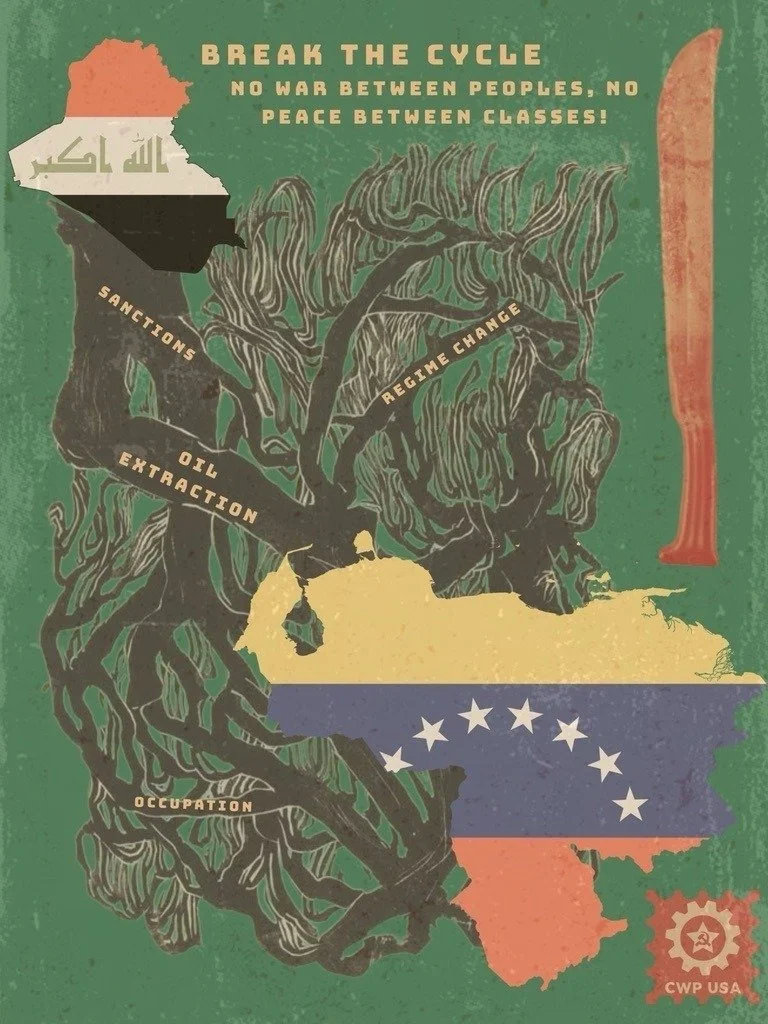
At the center of the confrontation lies oil. Venezuela’s vast hydrocarbon reserves have long positioned it as a structural problem for U.S. hegemony in the Western Hemisphere. When these reserves are not reliably subordinated to U.S. capital and geopolitical priorities, pressure follows − first economic, then political, and ultimately military. Sanctions, financial isolation, and the seizure of overseas assets have already inflicted severe damage on Venezuelan society. The current escalation, including open military threats and the de facto blockade of oil shipments, represents the logical extension of this strategy.
Imperialism rarely announces itself honestly. Instead, it cloaks material interests in the language of human rights, democracy, and security. Yet the mechanisms deployed against Venezuela − economic strangulation, diplomatic isolation, and the threat of force − are tools historically used not to liberate populations, but to discipline states that resist integration into spheres of influence of this or that power. The attempt to criminalize the Venezuelan state itself by branding it a “terrorist entity” is particularly revealing. Such designations are less about law than about creating a pretext for violence and expropriation.
Resistance Beyond the Government
One of the most persistent misconceptions in mainstream analysis is the assumption that opposition to U.S. intervention implies unconditional support for the Venezuelan government. This false binary obscures the real social terrain. Within Venezuela, criticism of the Maduro administration is widespread and often well-grounded, including from the Communist Party of Venezuela, working-class organizations, unions, and beyond. Economic concessions to private capital, the erosion of workers’ purchasing power, and restrictions on political participation have generated deep dissatisfaction.
Yet opposition to domestic policies does not translate into support for foreign domination. On the contrary, resistance to imperialist intervention cuts across political divisions. For many Venezuelans, U.S. military involvement represents not a corrective to internal problems, but a far greater threat: the loss of national self-determination and the transformation of social conflict into subjugation by the monopolies of a foreign power. Historical memory matters. Latin America’s experience with foreign intervention − whether in Guatemala, Chile, Nicaragua, or Iraq’s analogues elsewhere − has taught hard lessons about the costs of “humanitarian” wars.
This distinction is crucial. Anti-imperialism cannot be reduced to regime defense, nor can internal critique be outsourced to foreign powers. The insistence on Venezuelan sovereignty is not an endorsement of all state policies; it is a recognition that social transformation, if it is to occur, must be driven by popular forces within the country, not imposed by external coercion. The fate of Venezuela must be determined by the workers and people of Venezuela.
Militarization and Miscalculation
With Maduro now captured, the U.S. and its allies might assume that Venezuela's resistance would crumble, making any ongoing or escalated military involvement a low-cost endeavor. However, this reflects a dangerous underestimation of the country's political and material realities. Venezuelan society remains highly militarized, not just through its conventional armed forces, but via popular defense militias and grassroots organizations built over decades of defiance against external pressures. Even without Maduro at the helm, an invasion or prolonged occupation could face widespread guerrilla-style pushback, turning what was envisioned as a swift regime change into a drawn-out quagmire.
Venezuela's ties to rival global powers further complicate the picture, as these alliances have bolstered its defensive arsenal and shifted the strategic landscape. Equipment and support from these partners heighten the chances of broader escalation, making quick dominance unlikely. While the U.S. holds a clear military edge, raw power doesn't guarantee lasting control—history from Vietnam to Afghanistan shows how determined local resistance can drain resources and erode political will among invaders. Comparing this to Vietnam isn't exaggeration; it's a parallel where advanced forces clashed with a populace rejecting outside control. The outcome? Not freedom, but extended chaos, massive civilian tolls, and ultimate strategic defeat. With Venezuela's political future still uncertain, dismissing these risks could lead to even greater instability.
The Limits of Liberal Internationalism
Liberal defenses of intervention often hinge on the claim that sovereignty must yield to humanitarian necessity. Yet this argument collapses under scrutiny. Sanctions themselves have produced humanitarian crises by restricting access to food, medicine, and revenue. The same actors now invoking concern for Venezuelan civilians have actively contributed to the deterioration of their living conditions. This contradiction exposes the instrumental nature of humanitarian discourse within imperial policy.
Military intervention often wrecks a society's ability to rebuild real democracy, to transform society. When we speak of democracy, we speak strictly in terms of class. The character of democracy depends on the interests of the class who holds power. War breaks up communities and groups that hold society together, strengthens violent groups like militias or warlords, and shifts focus from open politics to strict security measures like curfews and checkpoints. In a nation already hit hard by economic woes, adding war impedes the ability of the workers and people to decide the path to true democratic progress.
In Iraq after the 2003 U.S. invasion, neighborhoods and communities splintered along ethnic and sectarian lines, leading to widespread distrust and isolation. Groups like labor unions and civic organizations that could have driven rebuilding were weakened or destroyed amid the chaos.
Libya's 2011 NATO intervention toppled Gaddafi but empowered rival militias and armed factions, who then fought for control, turning the country into a patchwork of warlord territories rather than a unified state.
In Afghanistan during the 20-year U.S. occupation, daily life revolved around military checkpoints, drone strikes, and anti-insurgent operations, sidelining elections and governance reforms. Political debates became secondary to survival under constant threat.
Syria's civil war, fueled by foreign interventions, devastated an already struggling economy, leading to hyperinflation and shortages that made organized democratic efforts impossible—millions fled, and authoritarian or extremist groups filled the void instead of fostering inclusive renewal.
Internationalism From Below
For those of us who hold high the banner of internationalism, the Venezuelan crisis poses a test of political clarity. Solidarity cannot mean silence about internal class contradictions, but neither can it mean complicity with imperial aggression. The task is to oppose intervention unequivocally while supporting the right of Venezuelan workers and popular movements to struggle for democratic and economic transformation on their own terms.
In the United States, this responsibility is particularly acute. Imperial policy is not an abstraction; it is funded by public resources and justified in the name of the population. Opposition to war is therefore not only an act of international solidarity but a domestic political obligation. The same structures that finance militarism abroad are implicated in austerity, privatization, and repression at home.
Venezuela’s future cannot be decided by aircraft carriers or sanctions regimes. The attempt to resolve social and political contradictions through imperial force will only deepen suffering and entrench domination. The choice is not between the existing government and foreign occupation, but between imperialism and self-determination.
For the communists, the position must be principled and clear: reject military intervention, oppose economic warfare, and affirm the right of the Venezuelan people to determine their own path − free from both external coercion and internal capitulation to capital. Anything less risks repeating the tragic patterns of the past under new ideological disguises.