
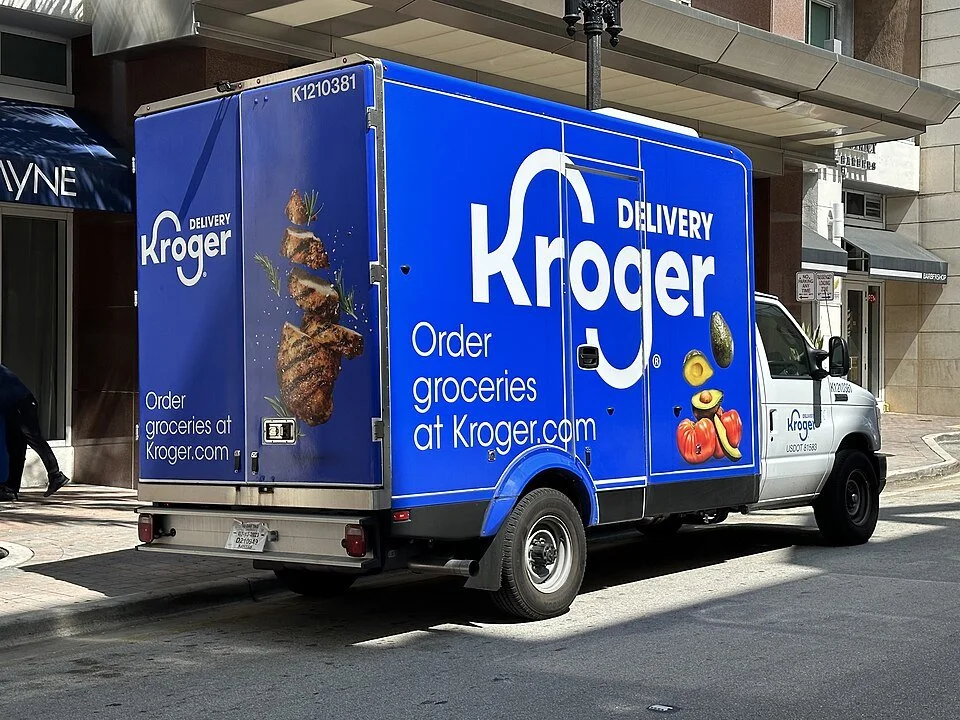
Kroger Delivery continues to be a crucial part of Kroger’s vision for the future. This vision of course includes a future where workers are exploited in all new ways. Beyond increase in total volume and personnel, one example of ways Kroger tries to squeeze out even more surplus value is from its ”turnaround routes.“ These are overall limited in scale, in the sense that they are not presently common. However, the workload they entail is no less gruesome, and understanding how is a brief lesson in exploitation itself. After talking to workers in the spokes, we have drawn up some estimates we believe accurately reflect the scale of Kroger’s routes, limiting ourselves to one spoke for anonymity’s sake.
For simplicity’s sake, we can ignore overall benefits, base pay, breaks, and certain other metrics regarding the routes themselves since these are not necessarily affected by whether someone is assigned a turnaround route or not. We will also not calculate the weight or the dollar value per hour delivered as the data makes no suggestion that this would vary in a way that isn’t explained by calculating the total weight per route (i.e. we can assume they‘re delivering the same $/pound) Finally, we will compare a 10.5 hour turnaround route with an average 8.5 hour route. With our variables now isolated, we can compare.
We currently estimate the standard route to average at 1600lbs, or 200lbs per hour accounting for a 30 minute unpaid break. The turnaround route however, functions differently than the average route. As the name suggests, workers complete one load, return to the spoke (distribution center) for their break, and then deliver an additional load (a entire extra route). We’ve calculated an average of 2400 for the total weight, or approximately 240lbs per hour. This is a 20% increase per hour in the delivery weight. Next is to address the two hours of overtime pay for turnaround routes. Let’s say two workers, one in each shift, makes $20/hr. The standard route yields $160 total, the other, accounting for two hours of overtime pay, $220 total. It’s important to understand that one of the ways that the capitalist can increase exploitation is by increasing the work day, since the wages you are paid over the course of the day is already paid for by the work one has conducted much earlier in the shift. However, we need to isolate the variable of overtime, (and prepare to demystify the deception being conducted by the capitalists.) Calculating in this way helps isolate the variation in the pay, or variable capital, of the last two hours of the turnaround route where the rate of exploitation would necessarily increase. To quantify it, instead of $20/240lbs, it becomes $30/240lbs(x2hours). The overtime pay might seem appealing at face value, as overall, it increases the total wage per hour, equating to $22/hr over 10 hours. But what does a 10% increase in pay add up in comparison to the increased weight? The standard route equals approximately $.10 per hourly pound. The turnaround route however, comes out to $0.9 per hourly pound(s). This means after isolating variables that have a direct effect on the differences in pay relative to weight, people working turnaround routes are being exploited at a rate approximately 10% higher than the standard driver over the course of an average day.
In short, longer days, more weight, less pay.
Not only are these workers being exploited at a higher rate, but some have reported being forced into these positions under the auspices that they were temporary. Or that they would only be conducting these routes occasionally and they would just have a 10 hour route with one load. This has turned out not to be the case for these workers. Furthermore, while these averages have been helpful and understanding, exploitation, mathematically, it must be understood that the weight can be much greater, with some workers reporting 2000lbs, 1 ton, in only their first route. They have reported exhaustion and fatigue from the increased volume of these routes. This highlights not only the increased exploitation, but the very material wear and tear on the worker that is not being accounted for.
Kroger has proven time and again it is willing to do what it can to exploit workers for profit, even picking at individual workers in the hopes that its workers will be none the wiser. What Kroger isn’t expecting is for workers to organize and actively fight against the exploitation of their labor. The turnaround routes must be combatted on the terms of the workers, as well as other nefarious methods to exploit and degrade the working class!