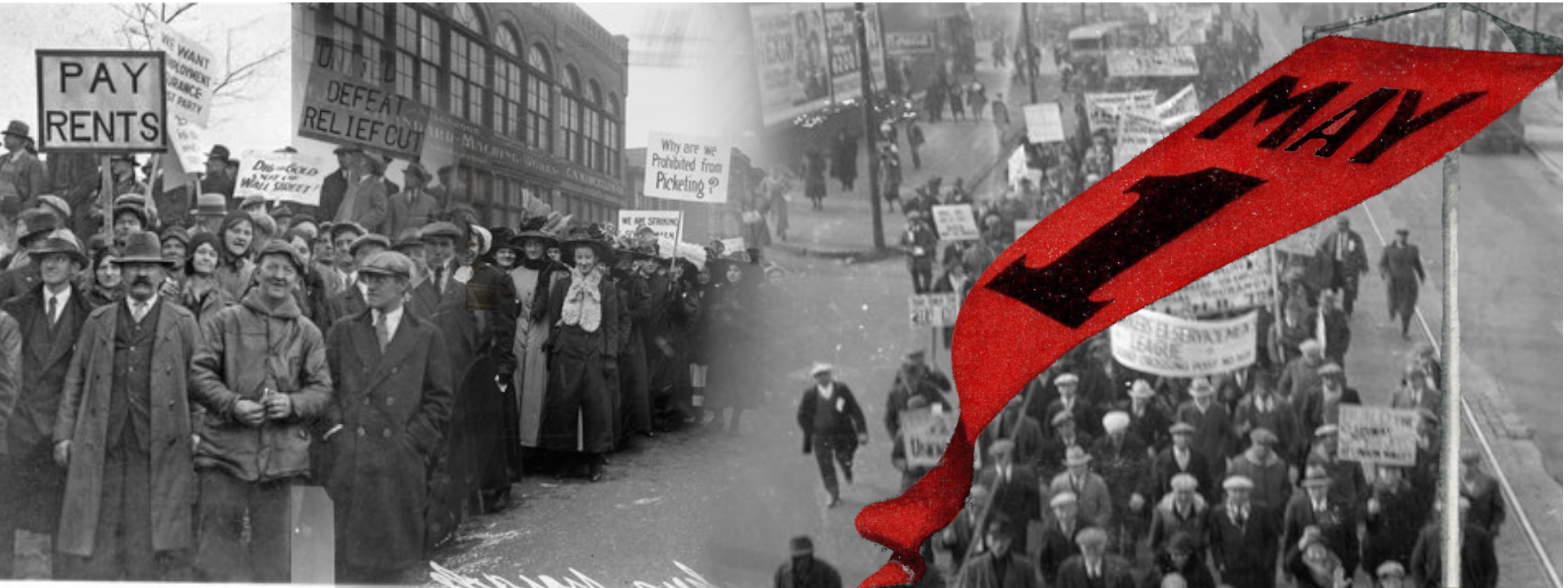
Photo credit: Chicago Historical Museum
Today, thousands of workers are expected to attend marches and rallies across the country, to recognize International Workers' Day: a day bound to the struggle of the international working class. May Day, which is observed around the world, draws its origins from the militant class struggles across the US and from events that took place in Chicago. Today, we reflect on the story of May Day, some history of Chicago's working class militancy, and draw from this history as we look toward the future of our necessary class struggle.
Origins of May Day and Chicago's Labor Organizing
Since the beginning of the factory system, workers have struggled for shorter hours and better wages. In the early 1800s it was common for workers to work 14 to 18 hours a day. “Eight hours work, eight hours recreation and eight hours rest” became the slogan that united the international working class. Labor organizing in the United States played a major role when the fight for 8 hours first launched nationwide. Leaders of different organizations came together with plans for a general strike on May 1st, 1886. After much preparation, hundreds of thousands of workers across the country collectively took to the streets, nearly half of them winning their demands.
Chicago was especially militant and organized. Tens of thousands of workers walked off the job on May 1st, marching down Michigan Avenue singing the unifying slogan, “We’re summoning our forces from shipyard, shop, and mill. Eight hours for work, eight hours for rest, eight hours for what we will!”
On May 3rd, police brutally cracked down on these striking workers at the McCormick Harvesting Machine Company. Six workers were killed by police and many more injured. More labor activists organized a protest for the following day at Haymarket Square. Just before the meeting ended, police antagonized the crowd leading to police opening fire on the workers, killing several.
The affair was used to demonize migrant workers and shut down remaining demonstrations. In response to calls for revenge, a sham court sentenced seven workers to death, arguing that their inflammatory speech had incited the violence. This grave miscarriage of justice drew global attention; thousands of working-class organizations in London signed a plea to save the condemned men’s lives. While four hangings went forward and capitalist reaction spread across the country, three years later the incident inspired the Second International to declare May 1st as a day for all workers to fight for the 8-hour day in honor of the Haymarket martyrs.
As railroads expanded across the US, Chicago developed into a central hub where shipping converged. George Pullman, a major manufacturer of railcars, promoted the construction of a company town to serve as a model of industrial harmony between capital and labor. The "utopia" Pullman described was, in fact, hell for the rail workers who received meager wages that were paid right back to Pullman through inflated rents, utilities, and food. During the panic of 1893, workers saw their wages cut and many were laid off. The workers decided they had enough and organized. In May 1893 they joined with Eugene V. Debs of the American Railway Union and organized a strike and boycott against Pullman which halted transport around the country. The strike, which inspired rail workers nationwide to join the union, was only broken when federal troops were sent to get the trains moving again. In the ensuing struggle, over 30 workers were killed. Despite ending in defeat, the strike broke the myth of possible unity between capital and labor, demonstrated the power of organizing, struck fear into the hearts of capitalists, and inspired the continuation of May Day as an annual day of widespread working class action.
Depression-Era Organizing in Chicago
Decades later during the Depression era, militant organizing in Chicago continued through the work of the Communist Party. While the first May Day strikes and the Pullman strike brought workers into confrontation with bosses, these actions lacked a clear aim of ultimately seizing state power. The Communist Party brought this clarity into their organizing work in Chicago by developing the class unity necessary to seize power for the workers. Their organizing concentrated on the city's south and west sides where they hosted cultural gatherings, markets, public readings, and developed the Chicago Workers' School to teach English and Marxism-Leninism. These activities brought white, black, immigrant, women, and youth into common cause with one another through mass class struggle. In the first five years of the depression, the Chicago Communist Party held over 2,000 demonstrations, and had the infrastructure to distribute over 200 thousand leaflets and newspapers during May Day 1930. They developed unemployment councils and led the city's most widespread industrial unionization efforts. Their militant organizing secured wage increases, the 8-hour workday, and led to unemployment insurance and social security becoming national policy.
The Current State of Worker Militancy in Chicago
The eight-hour day that workers fought and died for has been hollowed out by the capital's unending hunger for the profits our labor provides them. Many of us work longer hours across multiple jobs, while our wages cover less of our daily needs as inflation, high rents, utilities, groceries, and gas drains our cash. Jobs that supported whole families 60 years ago have been moved overseas, where capitalists find more exploitable labor and markets, even resorting to war to get this access.
The weakening of working class power has roots in coordinated efforts made decades ago to stifle the working class’ revolutionary potential. Union leaders in the AFL and CIO allied with the U.S. government, turning their backs on rank-and-file workers by buying off trade unions to subdue militancy. Strikes have seen major declines in key industries since 1970, and many states made striking illegal.
The Pullman strike was sabotaged by the refusal of capitalist-aligned AFL leaders to support boycott demands. Similarly, in 2023, the UAW spared major automakers a complete work stoppage by accepting wage increases insultingly less than what workers earned 20 years ago due to inflation. Yet even with union leaders truly dedicated to fighting for economic gains, the struggle between workers and bosses will never end until economic demands become political.
The federal government serves capital interests by setting ICE loose to intimidate and discipline workers, as happened last summer. In Chicago, ICE agents went to a picket line at the Mauser Packaging Solutions warehouse, weaponizing deportation as a threat against the migrant workers. Capitalists are clear in their exercise of political power over us workers to defend their economic interests. We must organize with that same clarity.
The interests of workers and bosses are in constant conflict. There is no such thing as a “fair wage” under capitalism—if workers were paid the full value of what they produce, nothing would remain for the capitalist. The capitalist seeks to squeeze more time and energy out of workers while the worker seeks to sustain themselves and retain time for rest and recreation. These are diametrically opposed interests. The struggle can end one of two ways: either we’re all mutually destroyed by capitalist greed, or workers successfully seize power to create a new world of socialism-communism.
This clarity is essential. May Day’s development in the late 1800s and early 1900s shows us our path: rallying around universal economic demands, fighting with collective work stoppages, and with the aim of workers establishing their power.
Today, however, May Day has been liberalized. Chicago Teachers Union leaders tried to turn May Day into a day off from school, into a state-sanctioned day of civic education instead of a collective show of worker’s power. Individualized actions (taking personal days) means nothing to the bosses and these benefit days are often only available to high-paid workers.
The very workers who could “shut it down”—manufacturing and transport workers—are absent from these talks! And the clarity of seizing power is obscured by progressive politicians who offer us false hope. Brandon Johnson, for example, reminds us that a worker-centered platform can’t succeed while capitalism reigns. When we listen to the underpaid lunchroom workers who are in the midst of a battle for better pay, the reality of Brandon Johnson and the “progressive” Democrat leadership's message stands in sharp contrast to the workers' demands.
The QSL Port workers in Chicago have been striking for safer conditions for over a year. But their union bureaucrats have turned for solutions from city council members, state legislators, and even to State Treasurer Michael Frerichs—who has invested billions into the Israeli war economy. These Democrats seek to “maintain Chicago’s reputation” for worker rights, but there is no reputation to celebrate while unsafe working conditions and low wages are the norm.
What Lies Ahead and What We Demand
Just imagine what Chicago could look like with workers in charge. Schools that truly center the growth and learning of children, rather than the development of obedient workers. Utilities and housing that don't rob us over half our pay checks. Healthcare that universally centers people's well-being that isn't withheld for the sake of profit. Reliable and safe transportation that gets us wherever we desire to go. And, most importantly, workers controlling and operating all the abundance of our labor in common. This vision is only possible if we workers organize to seize power.
Since the pandemic, new energy suggests the working class is waking up to the reality that our declining standards result from capitalist dominance. The last few years have seen massive multi-state strikes by GM, Amazon, and Starbucks workers. Chicago, in particular, has seen a rise in strikes and unionization across hotels, higher education, nonprofits, cooperatives, and most notably manufacturing and logistics—industries that can bring the country to a halt.
The mass mobilization of workers in Minnesota that culminated in the January 23 general strike, showed the potential of a militant movement. Unions mobilized thousands in a work stoppage against ICE terror. A militant working class recognizes its power and fights with determination.
These conditions set the stage for a rise in class consciousness in the US. Just as the Communist Party did in Chicago during the Great Depression, we need a party to unite workers and mass movements into a fighting organization. The Communist Party does not arise spontaneously—it emerges from the recognized necessity to establish socialism, guides workers in battles against capital, and aims to seize state power. Without this vehicle, our class remains vulnerable to opportunism, reforms, and repeated capitalist crises that bring mass suffering.
Reflecting upon the past, the present, and what our future can be, the CWPUSA sets the following demands for a Red May Day:
Strengthening the internationalism of the working-class movement, especially with the peoples of Cuba, Palestine, and all those under the malicious boot of imperialism
The closing and removal of all U.S. military bases abroad
The cessation of all imperialist agreements
The unity of the working class across industries
To elevate the worker's struggle around our social rights to education, healthcare, stable and permanent work, shorter working days, and safe working conditions
We recognize that to win and protect any of these social rights requires workers' power, through socialism-communism. A Red May Day must serve as a reminder that this is our ultimate struggle. The very history in this city, on these same streets, has shown us the way forward to a workers’ revolution.