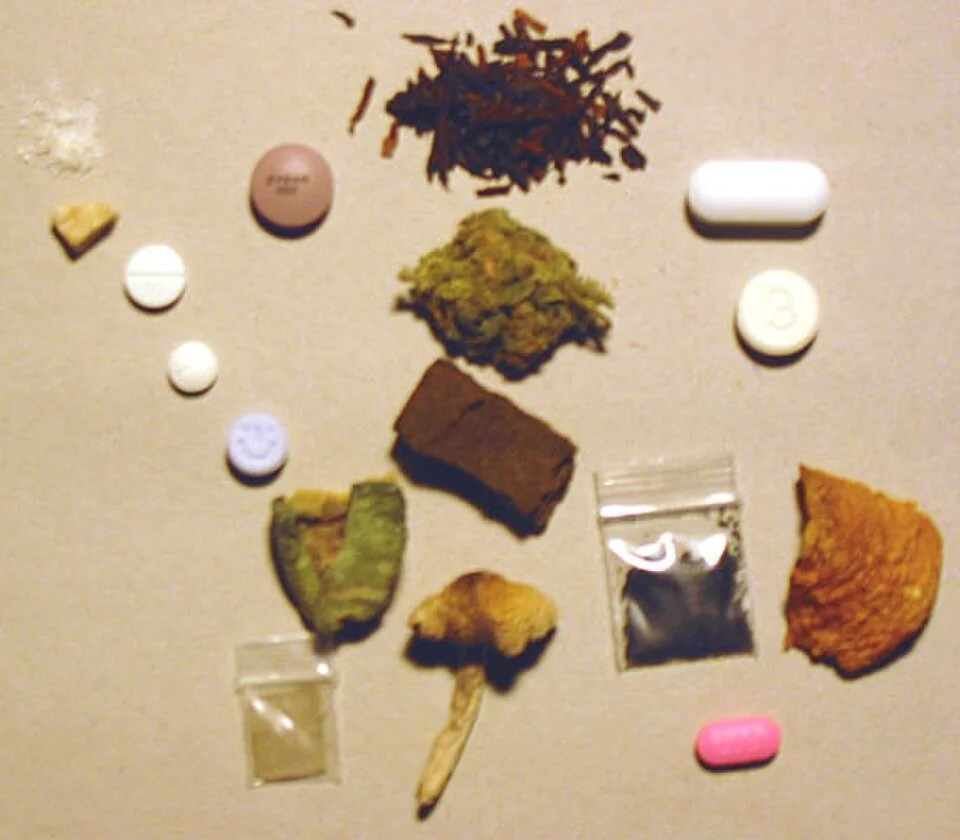
The distribution and use of addictive substances function as a field of profit by bourgeois states but also as mechanisms of social control. The user's removal from his social nature, his isolation and his conformity to the established order, combined with his passivization and demobilization from collective demands, constitutes the modern prison of the social subject.
In conditions of a war economy, the drug trade does not come out of the equation of profit and repression . On the contrary, it becomes the vehicle for further profitability and intensification of repression, both direct (consequences on the user) and indirect (consequences on society as a whole - social automatism).
The "war on drugs" and further repression
While drug dollars are a driving force in the largest stock markets in the world, which is a common secret among capitalists and their supporters, in the mid-1980s the "War on Drugs" became the anti-drug alibi for a series of imperialist interventions, a tool of social control in order to impose strategies of absolute control on drug-producing countries and a means of obtaining additional profits . A war, led par excellence by the White House and financed mainly by the big drug dealers and cartels.
Thus, bases were established (e.g. Bolivia and Peru), borders were militarized (e.g. Mexico), military attacks and even invasions were carried out with the ultimate goal of gathering forces in order to strike at the guerrilla movements that were developing in these countries (Colombia, Peru, Mexico).
At the same time, countries such as Colombia and Peru were the leaders in illegal coca cultivation and cocaine production, controlling most of the world's supply. "Anti-drug campaigns" for which military personnel were trained turned into operations to suppress guerrilla and anti-imperialist movements such as the Zapatistas in the Chiapas region of Mexico and the Sandinistas in Nicaragua, the operation against which was carried out by the Contras with money derived from the cocaine trade.
But even later, the "war on drugs" was supported by large monopoly groups and imperialist states, along with the spread of drugs around the world. Immediately after the invasion of NATO forces in Afghanistan in 2001, opium production increased 16 times, in 2004 it increased by 40%, while during the 20-year invasion, cultivation and production multiplied, with Afghanistan quickly becoming the world's leading producer and seller of opium.
The only areas not bombed by NATO were those where opium plantations were located. In 2004, 87% of the world's opium production came from Afghanistan. Thus, the war against the Taliban and narco-terrorism fueled a global opioid production laboratory whose trade branches out around the world with unimaginable profits.
Revenues from the illegal drug trade have historically financed paramilitary organizations and secret operations by government agencies, and thus drugs are even used as fuel for waging war.
Also recent is the example of the intervention in Venezuela, where under the pretext of "fighting the drug trade" and at a time when imperialist rivalries are intensifying in the context of increasing spheres of influence, the American energy monopolies openly targeted Venezuela's energy wealth and the control of a large part of the world's oil reserves.
Drugs - food for soldiers to stimulate the war machine
The use of drugs by soldiers during war is a historically documented practice. These substances were used both officially by military leaders to improve performance and unofficially by soldiers themselves to deal with psychological trauma.
The Wehrmacht and the SS made massive use of Pervitin, a methamphetamine preparation. This drug eliminated the need for sleep, reduced fear and increased endurance, facilitating the tactics of the “Lightning War” (Blitzkrieg). In 1940 alone, millions of such pills were distributed to the front. Towards the end of the war (1944), the Nazis tested an experimental pill (D-IX) containing cocaine, Pervitin and Eukodal (a powerful opioid painkiller similar to heroin), with the aim of creating “super-soldiers”.
British and US soldiers used amphetamines (such as Benzedrine) extensively to combat fatigue in pilots and crews during prolonged missions.
During the Vietnam War, the US military faced a widespread addiction crisis. Soldiers resorted to heroin, marijuana, and opium to cope with the horrors of war and the miserable conditions of the jungle.
The use of "recreational" and psychotropic pills by soldiers in Iraq is a phenomenon directly linked to intense post-traumatic stress disorder (PTSD), exhausting shifts and the horrors of war.
In recent wars in the Middle East, such as in Syria and the wider region, Captagon (fenethylline) has been widely used. This stimulant is used by fighters to gain hyperactivity, numb the feeling of pain, and stay awake for days.
The war in Ukraine has caused an explosive increase in drug use, leading soldiers to consume substances to suppress fear, stress and pain on the front lines. At the same time, there is a massive production and trafficking of new psychoactive substances, as the market for synthetic drugs records a huge increase.
The widespread use of pills and new psychoactive substances by Ukrainian soldiers is often a coping mechanism for the prolonged stress, insomnia and horrors of war. It includes the use of amphetamines and steroids, which are used to suppress fatigue and increase performance, giving the soldier a sense of invincibility, but also dangerous nitazenes (new synthetic opioids), creating crises on the front line.
On the black market, there are powerful painkillers adulterated with nitazene (even 100 times more powerful than morphine). Ketamine is also recorded among soldiers to deal with severe emotional stress. (Respectively, internationally, as in the US, MDMA is being experimentally examined for the treatment of post-traumatic stress in veterans).
The number of nitazine tablets seized has more than doubled recently, according to the 2026 International Drug Report, while a new synthetic drug is being produced every week. It seems that the proliferation of armed conflicts has not only not reduced drug production, but has increased production and consumption. In 2025, 50 new psychoactive substances were recorded in Europe for the first time, while in total the European authorities monitor around 1,050 different substances.
Drugs - mind suppression in wartime
In the 1970s, drugs were deliberately used in the anti-war movements of America and the Netherlands to degenerate them. In the 1980s, the FBI and CIA smuggled drugs such as crack , a cheap and highly addictive form of cocaine, into the slums of America, where poverty, unemployment and social exclusion made the populations more vulnerable and more dangerous to political stability. The goal was to suppress African Americans and break up movements.
The use of drugs by the civilian population in wartime is a long-standing and widespread phenomenon that functions as a survival mechanism, trauma management or economic exploitation, and an additional weapon of bourgeois states to increase social repression.
While historiography often focuses on the use of drugs by soldiers on the front lines, the effects on the general population experiencing the horrors of war are equally dramatic and multifaceted. Civilians in war zones face extreme fear, terror, loss of loved ones, hunger, displacement, and the daily threat of death. The use of drugs such as opioids (heroin, morphine) and cannabis is increasing rapidly as a means of “self-medication” to treat Post-Traumatic Stress Disorder (PTSD) and severe anxiety.
At the same time, in times of conflict, health systems collapse and access to essential medicines is impossible. For example, when hospital supplies of analgesics run out, the black market supplies opioids to help people manage pain from injuries or chronic conditions.
During the American Civil War and World War I, the widespread domestic use of morphine and opium for medical reasons led to mass addiction of hundreds of thousands of civilians and veterans after the end of hostilities.
But let’s not go too far. Tramadol (a powerful, synthetic opioid painkiller) has been the number one substance of abuse in Gaza for years. Due to the war, residents are using it en masse not only to cope with the physical pain of injuries, but also as an “anesthetic” for the horror of bombings and the loss of their families. Young people in Palestine are turning to polydrug use (the simultaneous use of illegal drugs and medications) to cope with Post-Traumatic Stress Disorder (PTSD), loss, and total exclusion.
Even after the war, in devastated economies, drug production and trafficking often becomes the only way for people to make a living . In the 1980s, with the worsening economic crisis, the rural economies of Latin American countries were transformed into drug economies.
Later, in Afghanistan, during decades of war, poppy cultivation for opium production became the main source of income for poor farmers, as traditional crops had been destroyed. In many cases, workers in war industries or under siege used stimulants (e.g. amphetamines) to be able to work grueling hours under the pressure of war, as was the case extensively in the urban environment of Nazi Germany with Pervitin before it was restricted.
The problem doesn't stop with the signing of an armistice
Addictions that develop during war are passed on to the next generation, sometimes with an increase in violence and delinquency. This is well known to the urban leadership, which on the one hand propagandizes in favor of use, on the other hand directly links use to specific social groups, even attributing it to refugee flows.
In this way, they try to collect the irreconcilable consequences of their policies that give rise to wars and poverty, but also to tighten penalties and strengthen repression in order to serve the needs of the economy each time, targeting the "culprit" and exonerating an entire system that gives rise to and reproduces drug use and trafficking, violence and repression.
In any case, civil legislation also adapts to the laws of the market. Sometimes in the direction of stricter regulation and sometimes in the direction of legalization and general relaxation, measuring how capital will be best served.
Drugs, moreover, constitute a huge field of profitability, which even in times of war serve capitalist economies in order to spread their capital into new markets, thus avoiding the fall in the average rate of profit and choosing cheaply produced substances.
In this context and despite the proliferation of new psychoactive substances on the war fronts, the European Drugs Action Plan 2026-2030 aims at specific repressive mechanisms to combat organized crime and the entry of drugs into the EU, without questioning the very factors that lead to the need to seek use and without strengthening measures to prevent and treat drug addiction, since in the context of the EU's war preparations, saving resources implies a squeeze on resources for prevention and treatment, privatizations and the use of NGOs.
And since in capitalism the purpose and content of research is shaped by profit, it is not surprising that the therapeutic effects of drugs, and specifically psychedelics today, in the treatment of mental disorders, post-traumatic stress, etc., have been retrieved from the crypt of history, recalling other times, when the German pharmaceutical company "Bayer" in 1898 advertised heroin as a "miracle" cough syrup and as a safe, non-addictive substitute for morphine.
In 2026, while mental disorders are the leading cause of disability worldwide and especially diagnoses for anxiety and depression show an increase of up to 158% from 1990 to 2023 according to the medical journal "Lancet", instead of preventive and treatment measures, even mental health dances to the rhythm of the war economy. The bourgeois states prepare their army by imposing additional repression. Drugs, both in the period of preparation and in the period of open military conflict, are the useful enemy of the people for the system, reducing resistance, reflexes, and fighting spirit.
In the face of this preparation, however, we are called to organize and plan our own preparation for the awakening and strengthening of our people. With the knowledge that what today seems immovable can be overthrown by the rushing river of the popular factor, which, as History has also shown, is not held back even by the mechanisms of manipulation when it realizes that it is it that can build a society without exploitation, without wars, without drugs.
Because as the poet said:
"General, the man is very useful."
He knows how to fly,
He also knows how to kill.
It only has one flaw.
He knows how to think ...
By Iliana Nazentiadou
* Iliana Nazentiadou is a member of the Department of the Central Committee of the KKE Against Drugs and Addictions, a psychologist - psychotherapist
Republished from Rizospastis