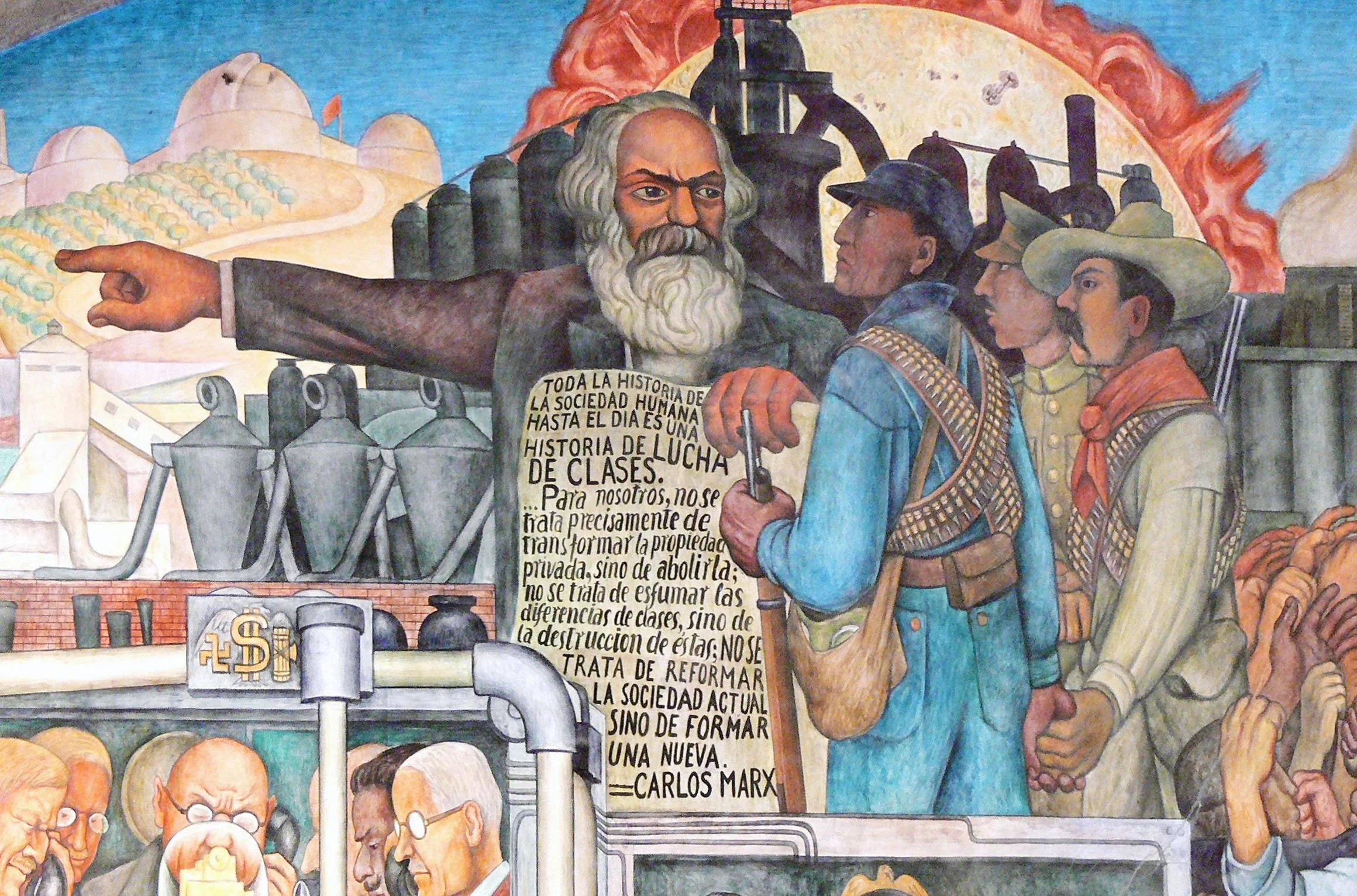
Diego Rivera, “Mexico Today and Tomorrow,” detail featuring Karl Marx, History of Mexico murals, 1935, fresco, Palacio Nacional, Mexico City
In July 2026, comrades of the CWPUSA attended the Sen Katayama Binational school organized and led by our comrades in the Partido Comunista de México (PCM).
The school covered a wide range of subjects, all of which are relevant to the current struggles of communists in the USA and internationally. The school consisted of a series of lectures and discussions that brought about an extensive understanding and overview of the subjects.
This is not an exhaustive explanation of the lectures, but rather a brief outline of the topics covered.
Dialectical Materialism
Dialectical materialism is the foundational philosophy of proletarian revolution. Its importance lies in the fact that it brings clarity and direction to the working class struggle.
The fundamental distinction of materialism as a philosophy is that it posits that matter comes before thought, and therefore, the ability to think in humans is a development of material substance. This is contrary to idealism, which posits the opposite: that thought precedes matter and thinking postulates, determines, creates, is reality.
Early materialists made a mistake in their understanding by assuming that things are fixed. Dialectical materialism was developed by Marx and Engels, with its core principles being that matter is constantly in flux (including consciousness) and that reality exists independently outside of ourselves. Dialectical materialism’s roots spring from Hegelian dialectics. Hegel, preceding Marx & Engels, was a towering figure in German idealist philosophy. What distinguishes Hegel’s dialectics from Marx and Engels’ is the fact that dialectical materialism uses dialectics to understand objective, material reality, rather than “the spirit”. It is important to note that there are many variants in idealist philosophy, from the subjective (relativism, solipsism) to the objective (religious thought, Platonism, Neoplatonism), but all of these seek to explain the fundamental notion that thought precedes matter.
Engels understood that rapid leaps in natural and historical science of his time brought a natural end to speculative philosophy, and logic and dialectics are the only tools left to understand the world. Formal logic is a critical tool in understanding the world, but dialectics is a necessary addition. While formal logic seeks universal rules within fixed systems, dialectical materialism posits that things change, therefore something might be true in a given set of circumstances and not true in another set. Dialectical logic is the logic of dynamism, of complexity.
Dialectics establish fundamental laws of reality: unity and struggle of opposites, negation of the negation, and transformation of quantity into quality. Negation of the negation implies that within every phenomenon, exists the negation of it. Quantity into quality implies that quantitative changes, for example boiling water turning into gas, transforms the quality of a given substance at a nodal point. Finally, the unity and conflict of opposites implies that all matter has an interplay of internal, mutually exclusive, opposite forces that create change and development through their interaction.
There are categories of dialectical materialism that help us further understand the material world. The ones that haven’t been addressed so far are essence and phenomenon (or, form & essence), and cause and effect. Essence and phenomenon is a category that addresses the internal and external elements of what presents itself to us. All phenomena present themselves to us as forms, but have an internal, objective essence. One essence can have many different forms.
The category of cause and effect addresses the reciprocal connections of interdependence, that there is a chain of phenomenon that produces other phenomena. And within these there are the necessary and casual, i.e. something that has to happen one way or another or something accidental.
It may or may not be clear at this point, what is meant by the notion that dialectical materialism is the revolutionary science. And it’s important to be clear that the Marxist-Leninist study of this science isn’t a form of intellectual exercise, but rather, a way of understanding the world and history in order to understand the revolutionary development of society and our role in it. Through it we understand that the development of humanity is inseparable from developments in the dominant modes of production. Throughout history we see the development of society has led to the necessity of revolution, to a new organization of the productive forces and relations of production. By applying dialectical materialism to our understanding of history and daily life, we can better understand our position within society, and why the proletariat is objectively the revolutionary class tasked by history to bring an end to class society itself.
History of the Communist International (Comintern)
In tracing the history of the Comintern, we have to start with the initial developments in the international class struggle. The First International, was an international political organization that Marx himself was a part of. It was made up of elements of the working class and left wing political groups. The variety of different thoughts led to the creation of different fractions inside of the organization; collectivism, communism, mutualism, a were the main ideologies, but if we dissect them the First International was essentially divided between anarchists and Marxists. This struggle of ideas is what ultimately led to the dissolution of the First International and much later on, the founding of the Second International.
The Second International was born out of a need for separation from the anarchist elements and unification into an organization concerned with socialist political aims. Although it began to cultivate ideas such as the notion of Bernstein, who hypothesized that Marx was incorrect and that a gradual evolution of capitalism through reforms would lead to socialism rather than a revolutionary approach. This is called reformism, a form of revisionism. At first members of the Second International such as Kautsky argued against Bernstein’s ideas, but later contradicted himself by pushing for reformist parliamentary approaches for the workers’ parties.
This by itself did not cause the International to dissolve, it was rather the onset of WWI, and strata within the organization adopting nationalist positions in a total betrayal of the working class struggle; added into the mix was the birth of the world’s first workers’ state in the Soviet Union that demonstrated a successful model for revolutionary action. Lenin spearheaded the founding of the new Third International due to the ideological bankruptcy of the Second. Lenin and the Bolsheviks thus pushed forward on an international level the idea–validated by the October Revolution–that the workers will not come to revolutionary conclusions spontaneously, but rather a revolutionary vanguard party was necessary to unite workers’ class instincts with revolutionary class consciousness. The model developed, the Party of a New Type, was one where the workers were the very structural foundation part of the party.
The Third International (or, Communist International) is where we find the development of the world communist movement gaining its footing. In the first and second Comintern congress there were diverse trends in the international movement that became parties due to the model of the Bolsheviks. Emphasis was laid on the fight against imperialism, the necessity of the dictatorship of the proletariat, the need for socialist revolution, ultimately a clarity was gained on the necessity of the fight and class struggle to its end in a contest for power against the capitalist class. The 21 conditions for joining the international were placed upon parties, and those that didn’t fulfill them were not able to join.
It is important to re-emphasize that the unification of groups into parties was crucial in this period of development. Parties were unified through programs, democratic centralism, and endorsement of the Bolshevik model; agitation and propaganda were systematized.
With the looming development of fascist elements in Europe we see that the parties in the Comintern had to answer the question of how to reach the masses, this led to the development of a strategy called the United Front. This strategy sought to join forces with the workers who were aligned with different political movements in order to fight the interests of the bourgeoisie. The obvious question here is how the parties could separate themselves and uphold integrity while being intertwined with opportunist forces. This, combined with the pressing question of how each party could implement the principles of the Comintern given that the conditions of each country vary led certain parties to devolve back into social democratic methods of organization and work.
With these developments came the various counter-revolutionary betrayals of social democratic parties. After WWI and the Russian Civil War, with the USSR gaining power and the live threat of working class revolution in dozens of countries, the bourgeoisie regrouped internationally, and thus emerged the necessity for a unified international program for the communists. The program developed by the Comintern pushed for a clear understanding of the goals of Communist Parties, and a roadmap for building socialism was clarified.
Fascism
Fascism is not a phenomenon that is separate from capitalism. Fascism does not develop from a vacuum or independent of the capitalist system. Rather, fascism is objectively a phenomena specific to capitalism, and arises when capitalism faces an existential revolutionary threat. It can be characterized by intensified repression, economic protectionism, abandonment of parliamentarism and intensified contradictions of the normal liberal order. The cornerstones of fascism appear as destruction of productive forces, closing of factories, development of different productive forces of capital accumulation, obscurantism, anti-scientific thought, and irrationality.
When bourgeois democracy fails to carry out its function of maintaining the rule of capital, the bourgeoisie mounts an offensive in the form of fascism. Rather than the varied forms of capitalist dictatorship, parliament, two-party systems, lobbies etc. fascism is an overt dictatorship of capital. The state becomes a corporate state, all classes must be subordinate to the state. Social demagogy is the strategy that fascism uses to create a mass movement. Appeals to nationalism, social chauvinism, and emotional triggers are generally used as a political platform. In this way it attracts the support of various classes within populations, with support from the military and police becoming crucial.
The political messaging of fascist movements often adopt anti-capitalist phraseology, they use this platform to stage a coup, but once in power their messaging changes to political and organic harmony among the classes. Fascism also takes shape as a counter-revolutionary movement, when communist political messaging becomes prevalent among the proletariat, it perverts that momentum to gain support and strengthen the rule of capital even further than before.
Trade Unions
Marx and Engels appear into the political landscape when unions begin to develop out of their initial stages. Marx and Engels conceived of trade unions as schools of socialism, where the working class takes its first steps to organize into a unified political force. Their objective was to urge the unions to move beyond just the economic struggle and into a broader political struggle.
In our current landscape, a big crisis began in 1991 with the defeat of socialism by reactionary forces, and a change in the landscape of unions as well. Yellow trade unions internationally have trumped red unions, and thus unions begin close collaboration with capital. In the US, these purges came earlier; the late 40s brought about the expulsion of communist elements from the industrial unions. Later on, in the Reagan presidency, the PATCO strike marked an emboldened war on unions in the US by the bourgeoisie. Deindustrialization in the west also reduced the unions in the industrial sector. These changes brought about less overall union membership as well as stifled militancy among unions.
The work of communist parties should be to raise militancy in unions, but this objective is not separate from fighting currents of class-collaborationism, as well as fatalism, and legal fetishism; all of which can be seen in the trade unions today. Class collaborationism and legal fetishism are pushed by the leaders and officials in these unions, but often these positions lead to losses in economic struggles. This leads to fatalism among the rank and file, and all of these phenomena must be fought to revive the militancy needed to create a broader political struggle.
It is from within the unions that this militancy can occur, and therefore the goals of communist parties are to find the more advanced sections within the unions and raise their class consciousness to the point where these workers recognize the need to combat the system as a whole. That being said, the struggle is also against reformism, while balancing the fact that workers rights aren’t something we should reject. The awareness of a party should be keen on the daily struggles of different sectors of the working class, its position on these matters, and finding opportunities to intervene and elevate the struggle in the trade unions.
Trotskyism
Bourgeois ideology takes shape in different forms. During and after the pandemic, there were many protests and strikes, these became breeding grounds for communist movements, but also movements that poison the proletarian current. Trotskyism, New Left, Maoism etc. Trotskyism has seen a resurgence in the recent past, entering into bourgeois governments, taking on the form of a communist party but ultimately serving to stall any real revolution. Some of these parties remove themselves from the Trotskyist label with a shamed face but still retain some elements. These parties today focus on ultraleft messaging, elevate individualism, and its leaders expel the majority, oftentimes due to the natural cult of personality they develop.
In recent years the prediction of Fukuyama of the end of history, that the USSR’s dissolution would lead to peaceful coexistence between countries has been totally contradicted by countries’ massive accumulation of arms. As we see through the more recent conflicts and previous conflicts this prediction cannot be true. In times like these, where the questions of the workers grow more urgent, these parties sprout like weeds to answer these questions. Where the communists should be, these charlatans rush to mislead the workers, bolster their own egos, and wash their hands of revolution, leaving the workers at the cruel mercy of history.
Trotskyists believe that Trotsky was a prominent leader of the Bolsheviks, this is not factual; Trotsky developed theories of permanent revolution and that the USSR was a degenerated workers state, and it must be brought to revolution from within. Trotsky developed fractions within the CPSU that participated in sabotage and wrecking, leading to the prosecution that followed. He also claimed that capitalism couldn’t develop further, a claim that was thwarted by the developments of productive forces after WWII. Prominent Trotskyists later had to struggle to adapt these theories, especially after decades of the USSR developing socialism further.
A main strategy of Trotskyism is entryism, where after a coup, members join other parties or groups, aim to germinate and gain influence from within. This makes Trotskyism sui generis, meaning it can only be defined by itself. This is because Trotskyism, through its main strategy, is transformed within the groups it tries to enter and this mutates the original cause. Oftentimes after the original group creates a caucus in another group, they leave. This distinguishes Trotskyist groups and parties by the fact that daily work is avoided, instead, a scavenger-like approach is adopted. On top of the contradictory conceptions of their theories, the efforts to join and change revolutionary parties ends up being at the cost of actually doing the revolutionary work itself.
The Revolutionary Communist International is an example of a party with its roots in Trotskyism, that tries to remove itself from Trotskyism, yet still has elements of it. Its roots sprout from The Militant, a Trotskyist group that penetrated the British Labor Party, and after being expelled, its leaders, for example Ted Grant, developed other groups. Later in 1992 it became the Committee for a Marxist International, and after some splits, The International Marxist Tendency. Following many divisions and splits this became the RCI, a “revolutionary party” which rejects the Soviet Union and Maoist China as “authoritarian regimes,” associates Stalin with the Mensheviks, Trotsky as the leader of Bolsheviks.
The RCI finds its membership in universities, seeking to attract radicalized youth into its ranks. The RCI ultimately has evolved from the initial Trotskyist principles and has created a party with the form of a communist party but is ultimately a counter-revolutionary force; it still upholds Trotskyist theories of permanent revolution, that capitalism has reached its pinnacle, that the USSR was a degenerated workers state etc.
Political Economy
Political economy is the study of production, distribution, exchange and their development, with production as the primary moment. Bourgeois economics absolutizes commodity exchange, and economic laws are determined accordingly, divorced from history. The Marxist understanding is that economic laws are not ahistorical. They are the expression of the relations of production, which are class relations, and they define material conditions, emerging from and contingent upon the mode of production they develop from and with. Political economy has been a subject of debate. Classical political economy (Smith, Ricardo) made real advances, the labor theory of value among them, but took capitalism to be natural and could not explain the historical specificity of its own categories. Marx’s critique of the classical school is the starting point of his work. Bourgeois economics after it generally falls into two categories. Positivism is a methodological stance which understands the economy as without general laws, i.e. without an inner essence, only tailing immediate developments with analysis. The other is Marginalism, where the core tenet is that the laws of capitalism are fixed, that value is subjective (a matter of utility), and they believe in the concept of scarcity divorced from historical development etc. Both treat the laws of capitalism as natural and eternal, and neither can explain the origin of surplus value.
Marx developed a scientific and thorough analysis of how capitalism really works, whereas the bourgeois economists only assign laws and rules of capitalism. The Marxist understanding is that the commodity is the primary unit of a capitalist economy, and these units contain within themselves use-values and exchange-values. Use-value relates to the usefulness of a commodity. Exchange-value is the relationship to other commodities in terms of how it could be exchanged, and it is the form of appearance of value, which is congealed abstract labor. Marx distinguishes concrete labor, which creates use-values, from abstract labor, which creates value and makes qualitatively different labors commensurable. This brings about a question of how to measure value, and Marx’s answer is labor time, more specifically, the socially necessary labor time to produce a commodity.
This is not a theory of barter, since value is the social substance underlying exchange in any commodity-producing society, including developed capitalism. But there are some obvious problems that develop in the form of exchange. A fisherman, for example, would have to exchange hundreds of fish to acquire a boat, because the boat embodies far more socially necessary labor time. The measure works, but direct exchange becomes unwieldy, and he must also find someone who happens to want fish at that moment. As exchange expands, one commodity is set apart as the general equivalent in which all others express their value. This creates the necessity of currency, and money arises from the development of the value form itself. Price is the money form of value. Money then becomes a significant factor in the economy, mediating simple circulation or commodity-money-commodity (C–M–C), where one sells in order to buy. Lending (asking for money has a price) is a later development. Money can also be accumulated, and capitalism as defined by Marx is not merely “an immense accumulation of commodities,” which is how wealth appears in capitalist society, but a system of generalized commodity production that includes wage labor and production for surplus value, so that what accumulates is capital.
There is still a problem. In the capitalist goal of using money to create more money there arises an obvious question: how can you make more money than the equal exchange-value of two commodities? Surplus value cannot originate in circulation, since the exchange of equivalents creates no new value and unequal exchange only redistributes what already exists. You would need a commodity that has the special character of creating MORE value when used. This then leads to the commodification of labor power, whose value is the socially necessary labor time it takes to reproduce itself, i.e. the means of subsistence of the worker and their family. The wage is the price form of this value and can diverge from it. Its use-value, labor itself, creates more value than it costs. C–M–C thus turns into money-commodity-money′ (M–C–M′), where M is money advanced, C is the commodities purchased, both means of production (constant capital) and labor power (variable capital), and M′ is the enlarged sum, M plus ΔM. The outcome is extraction of surplus value (ΔM). The exchange of wages for labor power can be an exchange of equivalents, but the buyer has purchased the right to use the worker’s labor power for a set time, and so also owns the fruits of their labor. Exploitation occurs in production, in the gap between the value of labor power and the value it creates. The rate of surplus value (rate of exploitation) is measured by the surplus value divided by variable capital, the capital advanced for labor power, and that times 100.
Finally, without diving too deep into the concepts, central to the development of capital are the following political economic concepts: the tendency of the rate of profit to fall as the organic composition of capital rises, though with counteracting factors. Competition leads to the concentration and centralization of capital, and companies turn into monopolies out of free competition (Lenin, Imperialism). Crises, the forcible resolution of capitalism’s contradictions (overproduction, anarchic production, etc.), accelerate this process. With it too capitalists begin to collectively own their property through shares (joint stock corporations, mergers & acquisitions), which Marx called the abolition of capital as private property within capitalist production itself. This separates ownership from management, creates a stratum of rentiers, and prepares the ground for finance capital, the merger of bank and industrial capital. The merging of capital with the state is a feature of the imperialist stage (state-monopoly capitalism).
Women’s Emancipation
Bourgeois demagogy claims that women are emancipated; portrayals of women as CEOs, presidents etc. serve to propagate the illusion that women’s emancipation under capitalism has been achieved. These claims are in spite of back steps in various countries, and the inability to address the question of working class women, who remain exploited. Oppression and inequality of the sexes can only be eradicated by ending exploitation. Bourgeois feminism claims that the exploitation of women is by men and that this exploitation has always existed, but the class based approach posits that the exploitation of women is based on the modes of production that generate the social relations of production.
Historically, beginning with hunter-gatherer societies, the division of labor between the sexes were based on biological advantages, which naturally led to development of different capabilities. This being the case though, these societies were matriarchal due to the non-monogamous, communal responsibility of child-care, whose outcome was that the maternal line was the only distinct lineage. This made women’s position in society very important, decision making and delegation of household resources were attributed to women.
Until the agricultural revolution and fabrication of tools. In this period, due to the accumulation of commodities with a longer shelf life and herding being attributed to males in a tribe, ownership and leadership are bestowed on men. This is how private property emerges and control of material means within society becomes dominated by men. This establishes a transformation that birthed patriarchal societies.
Within Greek mythology there are expressions of a struggle between the sexes that emerges from this, leading women to be confined to child care and alienated from the productive side of the economy. With this comes the development of classes, bosses, priesthood, etc. The primitive conditions are replaced by these contradictions and lead to slave based society. With this comes the development of humans being considered property, and forced marriages become a way to increase capital. Women thus are confined to domestic work, with penalties of death being enforced for offenses such as adultery. In every mode of production with divided classes, regardless of class, women were subjected to male domination. One of the few outlier cases being artisan women in the feudal mode who had some freedom due to their particular role in production.
The onset of capitalism brought with it the eventual influx of women into the proletariat. This introduces the wage gap; women were paid less as they were considered less valuable, this benefitted the bosses because they could exploit them more and it brought down the overall wages as well. This period brought women back into the productive forces, but as an exploited class, and still had less rights than proletarian men. This brought with it the necessity for working women to struggle for more rights in order to sell their labor power.
Today working women are encouraged to be part of the labor force with better advancement, but childcare is scarcely provided and the responsibility is placed on the individual parents. Within capitalism, reproduction of labor force is indispensable, within it falls the birth and care of children, which gave way to the nuclear family, in which domestic labor goes unpaid and is ultimately free. The question of women’s emancipation becomes a historical sum of the subjugation of women, which has its roots in the developing modes of production rather than cultural and religious phenomenon. It is only through material changes in the modes of production, in conjunction with active change in the relationships of families, men and women, that this emancipation can be made possible. For this reason, the role of women in the struggle for socialism-communism becomes indispensable.
A Message of Solidarity to the Comrades of PCM
The CWPUSA extends its utmost respect and appreciation to the comrades of PCM, who continue their exemplary dedication to the international proletarian struggle. We are honored to have been a part of this Sen Katayama Binational School, it is an indispensable part of our continuous development as an organization. The comrades from the PCM imparted vital lessons on the communist movement, and further showed us unmatched discipline and dedication to the workers’ struggle every step of the way. We take the example demonstrated to us by the PCM as a goal for the CWPUSA to constantly strive to construct in our own country.
The CWPUSA firmly stands with PCM in solidarity against the entire capitalist system that exploits and oppresses our working class brothers and sisters the world over. We stand shoulder to shoulder with our PCM comrades in this fight!