By Jane Reed
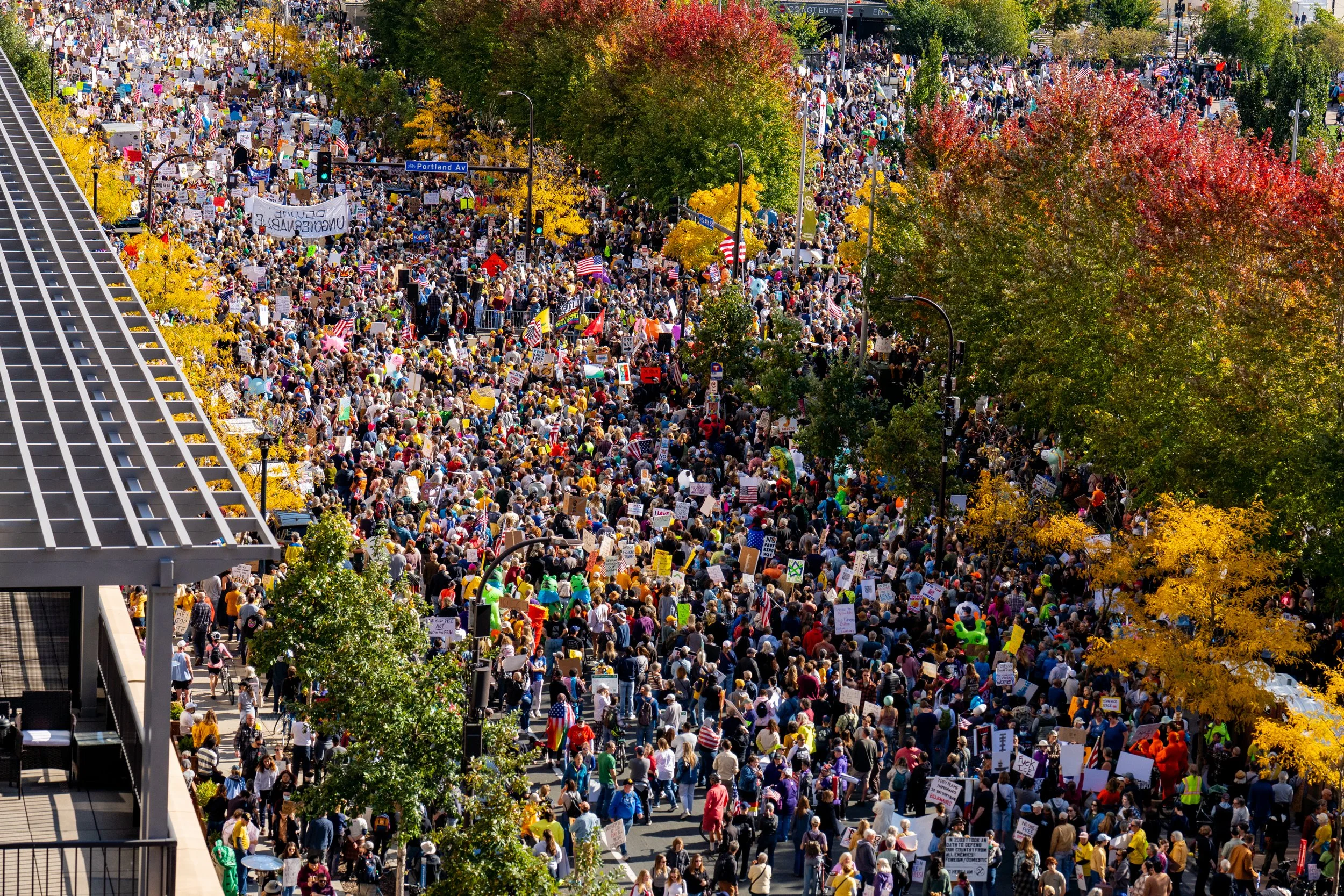
A common sentiment among many on the eclectic “Left” is total disillusionment with protests. Since there is no viable political option that represents the interests of workers, this frustration is worth engaging with in good faith. Most protests a worker would join are usually downstream of the Democrats and Republicans, leading absolutely nowhere for workers as a class, or else they’re organized by social democratic organizations that don’t fare much better (DSA, PSL, Green Party, etc.).
This is precisely because without a revolutionary political vehicle, without a context that seeks to end the rule of the capitalists, protests only serve to disseminate messages that either affirm or reform the bourgeois state. It feels completely inescapable. Workers attend protests and feel like little more than window dressing, feeling they’ve done everything they can, if not like they didn’t contribute at all. There’s no next step.
However, the party of the proletariat should not rule out under any circumstances the benefits of organized protest in general. Instead, protest should be understood within the proper political context. We need to build our connections to the working class, especially an organization as young as the CWPUSA. Our focus, first and foremost, is in the workplaces. However, finding advanced workers out in the field, workers looking for something that truly speaks to them, creates forces outside of the workplace that can be leveraged for support roles, such as distributing New Worker and conducting political agitation at targeted workplaces, or leveraging other skill sets like writing, administration, agitation, and propaganda. Since there is no viable party of the working class in the U.S., it shouldn’t be unexpected that sending cadres to conduct agitation creates opportunities to find these elements.
Protests are one of several ways we can test our forces as an organization. If we organize our own protests and can only mobilize a handful of cadres, it shows that our connections to the working class are severely lacking. If we’re able to mobilize many more workers than we have in our own ranks, this shows that our connections to the workers and our ability to mobilize them through coordination and planning is growing. Thus, we should view our own protests not simply as protests like the bourgeois politicians or the activists would, but instead as demonstrations used by militants to lay the indignation of the worker bare.
It is crucial to remind ourselves that our cadres must be flexible where conditions arise. Alliances are created based on our program without callously casting aside our positions for the sake of “unity.” Rather, demonstrations held by us allow us to assess our current level of strength and connection to the workers. Entering protests of competing forces to present our positions to workers without disguising them allows us to both agitate the totally uninitiated and identify advanced workers who already desire something more but are unaffiliated. It could even help us find potentially friendly organizations who themselves are disillusioned with watering down their mission on false practicality. It is crucial that we bring our own organized presence, our own agitational materials, our own slogans and chants, and that we do not for a second disguise ourselves or our intentions.
This is precisely why arguments that “protests are useless” and “we should do something more effective instead” deserve scrutiny. First and foremost, workers need to develop political consciousness, and having a political vehicle that can mobilize workers from the workplaces into the streets is a very powerful way of doing so. Secondly, by understanding that demonstrations have an alternative use for the communist party compared to the bourgeoisie, we see exactly what the metrics for a successful demonstration are: mobilization of forces, recruitment, and disseminating our political program. It’s about understanding demonstrations as a tool and how to leverage that tool. Demonstrations can of course also act as a deterrent, a way to communicate mass discontent with targeted conditions or policies. But without a political vehicle, the threat they pose to the bourgeoisie is limited, exactly as discussed earlier in the text, but now with a more enlightened and practical understanding that to grow into the party of the proletariat, we must go where the workers are.