The Decline of Liberal Arts – Communist Successors Await
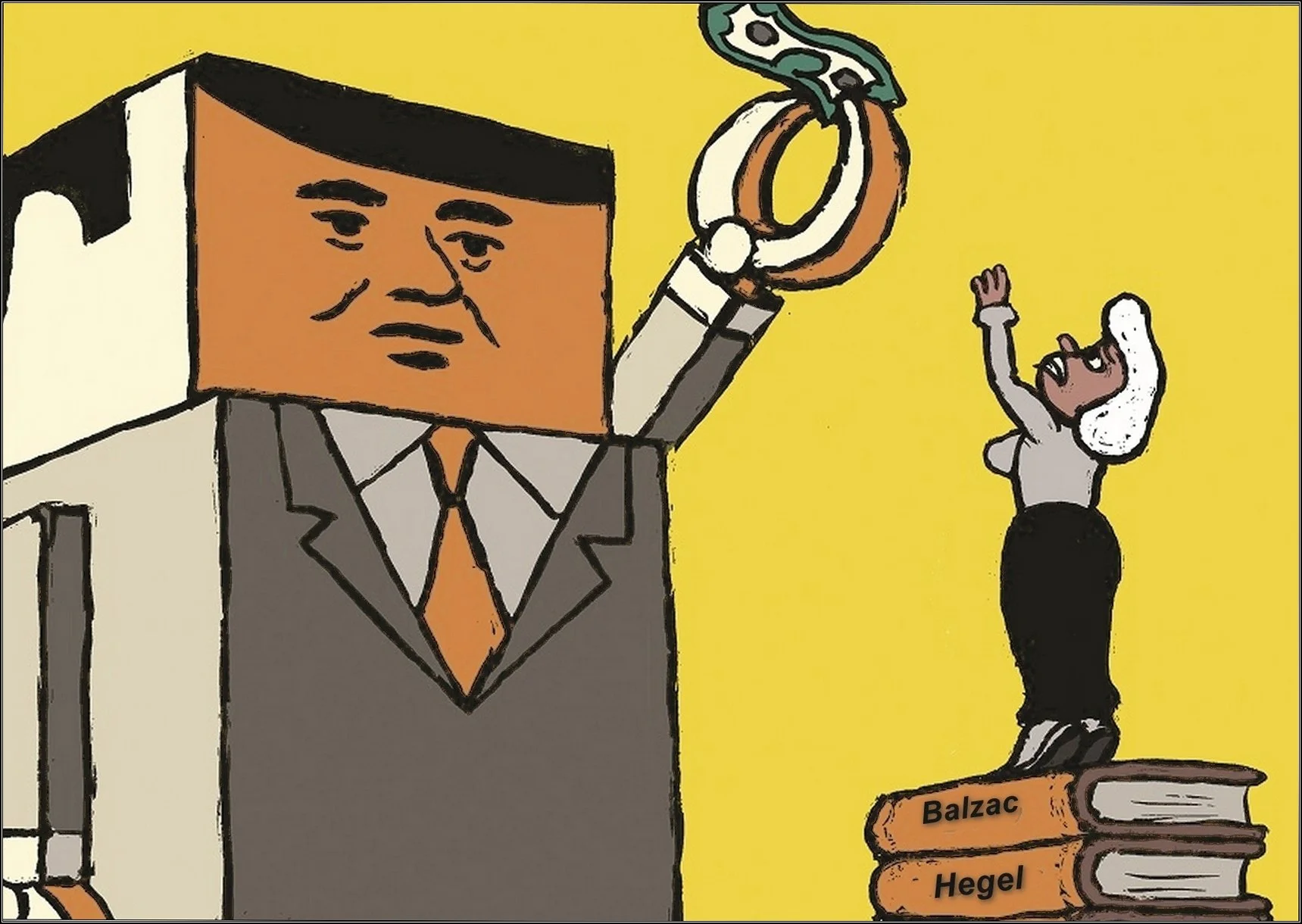
Professor Hakan Topol teaches media and art at Purchase College, a campus of the State University of New York thirty miles north of New York City. Cushy position, right? But he has just published a blistering attack on the destruction of liberal and fine arts at this top-ten-ranked college.
Topol calls out the turning of education into a commodity, the polarization of the staff into proletarianized instructors and money-chasing administrators, and the open political dictatorship:
“Consultancy firms, composed largely of MBAs with no stake in intellectual life, are routinely hired to redesign curricula, restructure departments, and recommend enrollment strategies. In 2023, Purchase College spent hundreds of thousands of dollars on Gray Associates, a consulting firm engaged to study enrollment trends.”
“Between 1976 and 2011, non-faculty professional positions, especially in student services and administration, grew by roughly 369%, while full-time tenured and tenure-track faculty grew by only 23%.”
“Between 2016 and 2024, average top salaries for administrators at Purchase College rose by more than 45%, while average assistant professor salaries rose by just around 14%. Cumulative inflation over the same period was 31%.”
In response to students’ protests against Israel’s genocide in Gaza, “Police were called in, and encampments were cleared. Students were suspended or even expelled. The same institutions that had dedicated years to publishing statements about critical thinking, civic engagement, decolonization, and land recognition moved against all of it the moment it became inconvenient.”
The consequence that matters for Topol is the destruction of liberal and fine arts education. It “produces … collective cultural and artistic imagination. It is the capacity to rethink form, to work across disciplines, to engage new and challenging ideas, and to build something that did not exist before.”
Liberal Arts in Capitalism — Then and Now
Topol wants to revive the glory and prosperity of the liberal arts. First, though, we must ask: what was the source of their esteem then, and why have they collapsed during the last fifty years? Most college students today get no more than a superficial exposure. One in six of the 2020-21 graduates majored in a liberal arts field, broadly defined. That is down from one in three in 1970-71.
In their heyday liberal arts colleges, and liberal arts departments at universities in general, molded the next generation of rulers, managers, and assorted professional staff. The capitalist class needed them to operate its political and social dictatorship. Most youth were from well-to-do families, but by the 1960s colleges enrolled a significant portion of working-class students, usually from white-collar families. Social mobility, when an exploiting system can afford it, relieves discontent.
More importantly, the liberal arts paid an ideological dividend. When rapid material progress was visible to all (and workers won some of it in class struggle), the liberal arts could celebrate the achievement, which they ascribed it to the march of civilization, to far-sighted capitalist development, and to the leisure of the few for the ultimate benefit of the many.
Capitalism is in decay now. Large, broad possibilities for profitable investment into new industries that need lots of workers to exploit no longer exist. Compare what used to be called “Detroit,” which extended to factories across the industrial Midwest and out to the coasts, with “Silicon Valley,” which means a handful of high-tech monopolies in a few favored cities.
U.S. capitalism condemns most people to a more and more difficult life. Education, career, a home, health care, and secure retirement slip out of our grasp. Consequently, the elevated, sweet enthusiasms of the liberal arts have lost their attractiveness for young adults. They and their parents scramble to finance a college education focused on the best possible job after graduation.
In this era – the terminal phase of capitalism in history – the liberal arts became arenas of opposed class outlooks. The Black civil rights movement and the U.S. war on Vietnam moved college students to independent awareness. They discovered that racism is much more than prejudice, that U.S. capitalism depends on it and fosters it. They learned that the issue in Vietnam was not a communist threat but imperialist domination to protect capitalist stakes in the region.
By 1970 Stanford University professor Roger A. Freeman, an advisor to Richard Nixon and Ronald Reagan, could not contain himself. He said at an Oct. 29 press conference, “We are in danger of producing an educated proletariat… We have to be selective on who we allow to go through higher education.” As California governor and then U.S. president, Reagan raised tuition from a nominal fee to a serious barrier, cut government funding of universities, slammed the brakes on student aid, and expanded loans for students, which they would repay from the earnings of a carefully chosen occupation. Now 48% of all bachelor’s degree holders take on student loan debt. Last year the average amount of debt they took on was more than $35,000.
Liberal Arts Are Bourgeois Liberal Arts
Professor-turned-administrator Jonathan Becker at Bard College is blunt about the class character of liberal arts. He celebrates “the role of liberal arts education in deepening and reviving the spirit of democratic citizenship (and in rejecting Marxist-Leninist orthodoxies).”
Communist intellectuals practice scholarship, not orthodoxy. It is hidden, but their achievement in the humanities is long and deep.
How does a capitalist economy work? You can get the basic answer from Karl Marx’s short Value, Price and Profit.
Frederick Engels explained the fundamentals of philosophy in his essay on Ludwig Feuerbach and the End of Classical German Philosophy.
Communist historians like Rodney Hilton did the major work on how feudalism gave way to capitalism.
In Dialectics of Nature Engels traced change through contradiction in biology, chemistry and other sciences.
Rigorous study of the history of science began when Boris Hessen from the Soviet Union spoke to the London Congress on the History of Science in 1931. He laid out a materialist method of historical research. Inspired by it, British scholars like Benjamin Farrington and Joseph Needham carried out magnificent scholarly careers. Farrington showed how science arose in ancient Greece and then stopped in its tracks. Needham dug up the entire history of science in China.
If you want to know how class outlook molds literature, see Barbara Foley’s Marxist Literary Criticism Today.
Most students at liberal and fine arts colleges will never be referred to any of these works.
The Democratic Socialist Sector in Bourgeois Culture
Until recently, the communist tradition was more often called the Marxist-Leninist outlook. Its bitter enemy on the “Left” is democratic socialism. There are important Marxist scholars of history, sociology, political economy, philosophy, literature, and the fine arts, but there is no school of democratic socialism embracing these fields.
Democratic socialism does have a niche in bourgeois “political science.” Prominent Yale professor Robert Dahl, for example, looked at the connections between political democracy, economic democracy, and a cloaked form of capitalism called market socialism. In all his writing about democracy, he stayed away from the fundamental question: democracy for which class? Democratic socialists 1) restate progressives’ criticisms of capitalist phenomena in more radical language and 2) take pains to demonize revolution and communism.
A columnist at Jacobin, the unofficial house organ of the Democratic Socialists of America, wrote an article, “The Left Should Defend Classical Education.” “The great books should be incorporated into every course of study, even the preprofessional.” Liza Featherstone refers specifically to Socrates and Plato. She has not a word about the great communist books. Her call for classical revival is like the “No Kings” demonstrations: they want to go back to a better time. But periods of relative mass prosperity under capitalism, able to sustain liberal bourgeois arts, are gone forever. The only way out is the way forward beyond capitalism.
Actually, there is a way to look back in order to advance. Lenin insisted, “Marxism … has assimilated and refashioned everything of value in the more than two thousand years of the development of human thought and culture. Only further work on this basis and in this direction … can be recognized as the development of a genuine proletarian culture.” The challenge is to find the leap from bourgeois culture to working-class culture; from citizens granted a vote for their oppressors to workers who run society; from worn-out wage slaves to proud workers who show each other problem and solution through the arts. Some of this cultural revolution begins under capitalism, but it will not roll strong until we overthrow capitalism and set out on the socialist-communist path.
Communist Culture for All Workers
The key to communist culture among all workers and students, regardless of the formal education they got, is to pursue it in connection with every kind of social activity.
When we are out on strike, or confronting ICE thugs on the street, or demonstrating against the U.S. imperialist stranglehold on Cuba, there are moments in preparation before and in reflection after to ponder and discuss the wider perspective.
The members of a communist group must always have a project of deeper study going. The basics of Marxism-Leninism are the core, which can be surrounded by study of wider communist culture
After we see a movie or read a novel, we can ask, what is the truth in it? How did it deliver that truth to us? We may compare it with other movies or novels, read up a bit on the historical period, and seek whether communist criticism has been written about the essential problem.
When we plan a social event, we can draw on art, music, poetry, and rhetoric so that it becomes a communist cultural event. We can ask ourselves, how does this work of art convey its insight?
History, political economy, theater, poetry – all communist culture – can help us fight better, with a grasp of the big picture and therefore with deeper commitment.
Now sixty centuries of cruel toil
Are shaken and toppled by class reason.
And we workers, our hour come round at last,
March toward a great and fine life for all.
Charles Andrews is the author of The Hollow Colossus and other books.
A list of his occasional essays is at http://www.hollowcolossus.com/moreCA.htm