
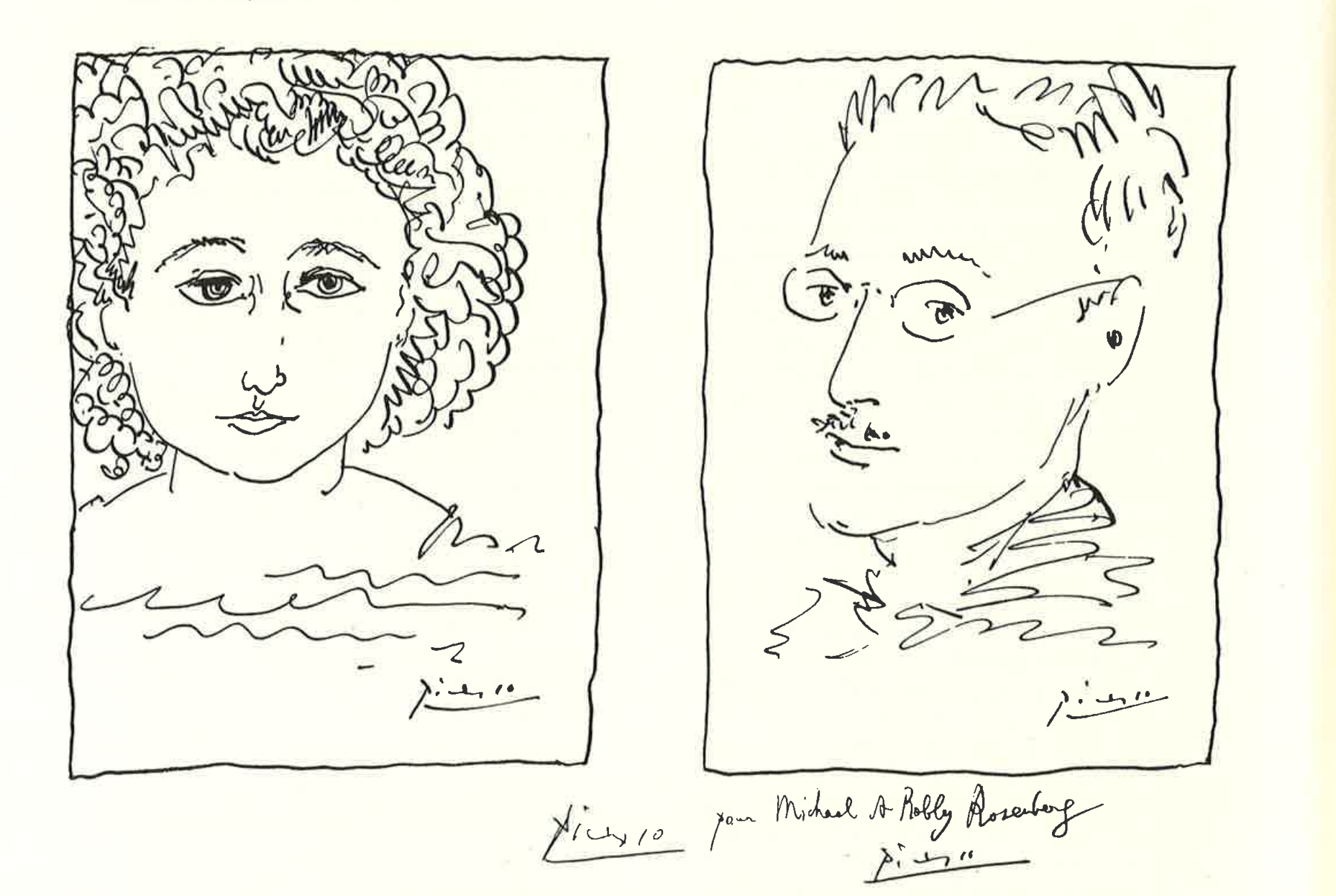
Image Source: https://www.marxists.org/subject/jewish/ch-rosenberg.pdf
Editorial Note
June 19 marks the murder of two of the most famous victims of McCarthyism in the US - scientists and communists - Julius and Ethel Rosenberg. The judge who presided over the case, Irving Kaufman, was a staunch anti-communist and a loyal follower of Joseph McCarthy. The innocent Rosenbergs had to be killed as an example - just like the two Italian workers Sacco and Venzetti. Taking place from 1951 - 1953 , the trial was held in period when the Soviet Union had announced it obtained the atomic bomb, ending the US monopoly on atomic weapons, preventing the ability of the US to wage atomic terrorism on other countries.
The execution of the Rosenbergs was a result of this strategic defeat of US imperialism and part of the anti-communist and anti-Soviet delirium in the US; the Red Scare. Their murder was an element of preparing the ground for US imperialist intervention in Korea under the pretext of “defeating communism”. The memory of the Rosenbergs lives on in the memory of those of us who aim to be the permanent nightmare of this state and its class who are responsible for their murder.
Below we republish an excerpt from the book “The Rosenberg Case: We Are All Your Children” which gives a historical account of the false charges, in addition to the final letter of Ethel to her two sons. All additions in brackets are notes from the editor.
Excerpts from “The Rosenberg Case: We Are All Your Children” by Vicki Gabriner
In 1945, the United States exploded atomic bombs in Hiroshima and Nagasaki, Japan. North American scientists estimated that it would take the Soviet Union, our ally at the time, about four to five years to develop atomic weapons. Politicians and the public estimated it would take much longer.
In September 1949, President Truman announced the explosion of a Soviet bomb. By that time, the Cold War had begun and by June 1950 it got hot again with the outbreak of the Korean War. Joe McCarthy was witch-hunting Communists - spy-hysteria and the search for scapegoats was on.
Julius Rosenberg was arrested in July 1950 and charged with conspiracy to commit espionage, Morton Sobell was kidnapped by U.S. agents in Mexico, brought to the United States, and charged similarly. Ethel Rosenberg, Julius’s wife, was arrested in August, and also charged.
The Rosenbergs had been “fingered” by David Greenglass, Ethel’s brother. It was called the Spy Story of the Century. The FBI claimed to have cracked an international spy ring that was passing atomic secrets to the Soviet Union. Links were alleged with Klaus Fuchs, a British scientist who had worked on the development of the atomic bomb in Britain and the United States, and who was a self-confessed Russian spy, and also with Harry Gold, who turned himself in and said he was Fuch’s American courier.
Ethel Rosenberg, thiry-four, and Julius, thirty-two, were the children of poor Jewish immigrants, who had grown up and still lived on the Lower East Side of New York. They were ardent trade unionists and leftist political activists, probably members of the Communist Party [CPUSA]. They had two small sons, Michael, seven, and Robby, three; Morton Sobell came from a similar background.
It was difficult to get lawyers; most were afraid to touch the case. And once Emmanuel Bloch was hired, it was difficult for him to get support. Legal tactics for such a case had not been well developed.
The trial began March 8, 1951. It was eight months after the arrest, ample time for all three defendants to have been convicted in the press.
The judge was Iriving Kaufman, then one of the youngest federal judges on the bench. All Jews and liberals were systematically excluded from the jury, which was not sequestered during the trial.
The trial was filled with inconsistencies, flimsy evidence, irregularities, and illegal activities on the part of the government.
The only evidence against Sobell was presented by his former friend Max Elitcher who, with uncorroborated testimony, tied him to the conspiracy, but not to the passing of atomic secrets.
The crucial testimony against the Rosenbergs came from David and Ruth Greenglass. Central to that were sketches allegedly given to Julius by David. The drawings entered as evidence were not the originals; they were done by David from memory before the trial.
There are three critical issues around this supposedly valuable information from Greenglass. (1) Greenglass was a high school graduate with a low-level job at the Los Alamos atomic bomb project - a machinist - hardly qualified to understand the complicated physics involved in atomic research. (2) Most respected scientists have testified that there was no atomic secret; the Soviet Union was developing its own atom bomb. (3) Greenglass’s sketches were elementary and useless. In any event, the “secret” of an atomic bomb cannot be described in several sketches.
David and Ruth Greenglass’s testimony was to some extent corroborated by Harry Gold, but Gold never claimed to have known the Rosenbergs. Gold was also an admitted perjurer.
One of the main irregularities of the trial, if that is even an accurate word, was Kaufman’s partiality to the prosecution. It has since come out in documents released in the Freedom of Information suit filed by the Rosenberg sons, Michael and Robby Meeropol, that Kaufman was involved ex parte (one-sided) conversations with the prosecution throughout the trial, coaching them on how to best present their case, and in turn being briefed by them. Kaufman has continued to maintain contact with the FBI on this case up to the present day.
The jury was out for one day and returned convictions for all three. Seven days later, Kaufman imposed the death penalty on the Rosenbergs stating, “...I believe your conduct in putting into the hands of the Russians the A-bomb years before our best scientists predicted Russia would perfect the bomb has already caused, in my opinion, the communist aggression in Korea, with the resultant casualties exceeding fifty thousand and who knows but that millions more of innocent people may pay the price for your treason. Indeed, by your betrayal you undoubtedly have altered the course of history to the disadvantage of our own country…I feel I must pass such sentence upon the principals in this diabolical conspiracy to destroy a God-fearing nation…” The death sentence was supposed to have a persuasive value, particularly for Ethel. Morton Sobell was given thirty years, and Kaufman gratuitously recommended no parole.
The Rosenbergs maintained their innocent until their death two years later on June 19, 1953. During those two years, they were kept isolated in the Death House in Sing Sing [max-security prison in Ossining, New York]. Although new evidence was uncovered between 1951 and 1953, all their appeals were turned down. The case was never reviewed by a higher court. A worldwide movement of notable and masses of people for clemency developed.
On the day before the execution, Supreme Court Justice William O. Douglas ordered a stay of execution, which would have meant life until the Supreme Court’s fall session in October, 1953. The Chief Justice, Fred M. Vinson, called the Court into extraordinary session on June 19, 1953, and vacated the stay. Eisenhower refused to issue an executive order of clemency. Judge Kaufman pushed the hour of execution up from 11 p.m. to 8 p.m. as not to desecrate Jewish Sabbath.
After the Rosenberg execution, the defense movement turned its attention to Morton Sobell, who had begun to serve his thirty-year sentence at Alcatraz, the harshest of all federal penitentiaries. All his appeals were turned down, and he was not released from prison until 1969, eighteen years and five months after his arrest.
Michael and Robby Rosenberg, after many legal hassles, were legally adopted by Anne and Abe Meeropol, supporters of their parents. They assumed the name Meeropol; their identity and the trauma of their childhood were carefully concealed for the next twenty years.
In 1965, Walter and Miriam Schneir published “Invitation to an Inquest”, which disclosed new evidence. In 1973, Louis Nizer published “The Implosion Conspiracy”, which proclaimed the guilt of the Rosenbergs and used their death-house letters without the permission of Robby and Michael. It was at this point that the sons decided to make public their identity and sue Nizer for invasion of privacy. [The courts sided with Nizer and ruled in the author and publishing companies].
In June of 1974, the first public tribute to the Rosenberg was held at Carnegie Hall in New York. Several months before that, the National Committee to Reopen the Rosenberg Case got rolling.
In February of 1975, the Meeropols made a request under the Freedom of Information Act (FOIA) for the government files in their parents’ case; in July they filed an FOIA suit against the government.
Only the tip of the FOIA iceberg has been released thus far, but even so it reveals more illegal and underhanded maneuvers than were known before.
Ethel Rosenberg wrote to her sons the day of the execution:
Dearest Sweethearts, my most precious children,
Only this morning it looks like we might be together again after all. Now that this cannot be, I want so much for you to know all that I have come to know. Unfortunately, I may write only a few simple words; the rest of your own lives must teach you, even as mine taught me.
At first, of course you will grieve bitterly for us, but you will not grieve alone. That is our consolation and it must eventually be yours.
Eventually, too, you must come to believe that life is worth the living. Be comforted that even now, with the end of ours slowly approaching, that we know this with a conviction that defeats the executioner!
Your lives must teach you, too, that good cannot really flourish in the midst of evil; that freedom and all the things that go to make up a truly satisfying and worthwhile life, must sometimes be purchased very dearly. Be comforted, then, that we were serene and understood with the deepest kind of understanding, that civilization had not as yet progressed to the point where life did not have to be lost for the sake of life; and that we were comforted in the knowledge that others would carry on after us.
We wish we might have had the tremendous joy and gratification of living our lives with you. Your Daddy who is with me in the last momentous hours, sends his hear and all the love that is in it for his dearest boys. Always remember that we were innocent and could not wrong our conscience.
We press you close and kiss you with all our strength.
Lovingly,
Daddy and Mommy
Julie and Ethel
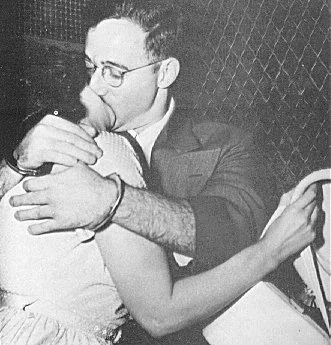
Image Source: https://famous-trials.com/rosenberg/2228-home