Lessons from October 2, 2026
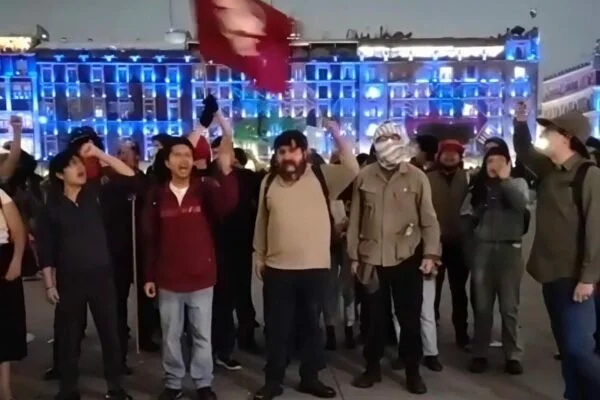
As it has every year since 1968, the student and worker-popular movement pays tribute to those who fell on October 2 in the Plaza of the Three Cultures in Tlatelolco, in what is now recognized as a state crime for which former presidents Díaz Ordaz and Echeverría Álvarez, as well as the Mexican Army and the now-defunct Federal Security Directorate, bear responsibility.
This time, the defining feature was the repression carried out by the Government of Mexico City, with the Federal Government also bearing responsibility. Both are controlled by the social-democratic party MORENA.
At 1:00 p.m., after leaving a Party office in the Historic Center of Mexico City, a team of ten comrades from the Party and Communist Youth, carrying the flags, banners, newspapers, megaphones, and other propaganda materials needed for our contingent, which was to begin assembling at Tlatelolco Metro station, was intercepted and surrounded by approximately 60 mounted officers from the police unit known as “Potros,” under the command of R. Ramos. The police immediately began delivering blows and beating the comrades with metal rods. Comrade Miguel Uribe, a member of the Central Committee of the PCM, was placed in a chokehold and struck several times. Comrade Ernesto Santrich, Political Secretary of the Communist Youth Front, received three punches to the ear while being shoved against a wall, as well as blows to the stomach. Comrade Ágata was kicked in the back and stomach and subjected to sexist insults. Comrades Raymundo, Salvador, and Alexander likewise received a barrage of blows.
The repressive force isolated Comrade Miguel Uribe and threatened to arrest the other comrades if they did not stop shouting slogans and leave. After surrounding Comrade Uribe, the head of the “Potros” unit interrogated him. Upon examining his identification documents, he threatened that, if Uribe filed any complaint or report, they would go to his home and arrest him. He then began recording a video, asking what the bottles were going to be used for. The comrade replied that we were not carrying any bottles. Angered, the henchman said, “You ruined my video,” extended a collapsible baton, and viciously struck the comrade’s knees. He resumed recording, asked the same question, received the same answer, and proceeded to keep striking the comrade’s knee. When the comrade refused to cooperate, the officer began demanding the password to his phone. The comrade refused again, and the officer repeated the process, continuing to strike his knee with the baton while declaring, “You won’t march again.” Other repressive officers told the comrade to answer the “big boss’s little boy” already, referring to an officer directly connected to César Cravioto Romero, Secretary of Government of Mexico City. When they failed to obtain the response they wanted, they sent the comrade to the court to be processed. While he was detained, several noteworthy things occurred. First, he was offered his release in exchange for admitting to an administrative offense of urinating in the street and paying a fine of 3,000 pesos. The comrade rejected the offer. They then attempted to make him sign a statement declaring that his offense was administrative and in no way political. In the end, unable to bring any charges against him, Comrade Miguel Uribe was released. However, 100 PCM and Communist Youth flags, three megaphones, and other materials were unjustifiably confiscated by the Government of Mexico City. After independently seeking medical evaluation, the comrade was diagnosed with bursitis in his knee, which also resulted in two weeks of work incapacity, without ruling out other possible complications.
This repressive operation, which began early with an attack on the Communist Party, continued against the student and popular movement as a whole, with the deployment of more than 4,400 riot police, now referred to as anti-riot officers. Extensive evidence has circulated in the media and on social networks showing the pattern of police conduct: suppressing and repressing the mobilization before it could even begin. Student contingents leaving UNAM were harassed and beaten. Upon reaching Tlatelolco Metro station and the surrounding area, student and popular contingents were beaten, had their belongings confiscated, had their phones stolen, and were even sprayed with fire extinguishers by a hundred mounted police officers who invaded the station’s pedestrian plaza.
Several journalists from different media outlets were also beaten, and their cameras, computers, and phones were stolen. Among them were Iván Ortíz of El Sol de México and Mario Marlo of Somos el Medio. It is worth noting that, despite these events, the mass media made little mention of these openly repressive actions, beyond the usual characterization of “clashes between protesters and police.”
After several days, there has been no official disavowal of these actions, much less any investigation or punishment for these extensively documented crimes. All of this stands in sharp contrast to the official rhetoric, which brazenly claims that this government has put behind it the repression experienced 58 years ago. In light of these events, that claim is pure demagoguery.
We want to draw lessons that may be useful to the worker, popular, and student movement as a whole.
Since arriving at the National Palace in 2018, the social democrats have claimed that the country has changed. The reality, however, is that the mechanisms of state domination have been strengthened through militarization, the creation of new repressive forces, new and concealed cooperation agreements with US police and repressive agencies, and the discrediting and criminalization of every worker-popular struggle that takes a class-based and anti-capitalist perspective and remains independent of MORENA.
This continuity has resulted in the murders of 199 social activists and environmental rights defenders over the past 12 years, between 2015 and 2025, during the governments of Peña Nieto, López Obrador, and Sheinbaum Pardo [1], not counting the disappearances. The advance of the monopolies has imposed a silent death sentence on the defense of territory, the struggle for water, environmental protection, and popular resistance to megaprojects and energy extractivism—and, more broadly, to social struggle.
However, it was the CNTE teachers’ strike last June that revealed a new modus operandi, of which the October 2 operations are a clear continuation. It was at that point that the “Potros” police unit emerged as an operational force: a mounted unit that attacks people participating in mobilizations, assisted by the C-5 surveillance center and acting under the authority of the Secretary of Government of Mexico City.
In June, we witnessed its actions against the general secretary of CETEG near Azteca Stadium and against the Ayotzinapa teacher-training college at the Tlalpan toll booth. Certain regulations concerning human rights that the social mobilization had managed to impose on police conduct ceased to be respected from that point onward. We have returned to a phase of impunity, abuse, police violence, criminal attacks, the planting of “evidence,” illegal arrests, restrictions on ideas, confiscation of political materials, political surveillance, and so on. From there to the prohibition of demonstrations, political prisoners, and political assassinations is not a great distance.
One underlying element in this situation is the ruling class’s approval of social-democratic governance in its role of demobilizing society and acting as guardian of “social peace” and stability. Over eight years, it has enabled superprofits for the monopolies and improved the position of Mexican capitalism within the imperialist system. Social democracy will not abandon this role, even if it must shed its image as a defender of democracy and the people’s political rights, because this role guarantees its continued hold on government.
We see similar scenarios unfolding in other countries, where social-democratic governments that came to power under the banner of progressivism are increasingly implementing hardline policies against mobilization and social protest. Such protests arise naturally from the unresolved needs of the working masses during this period of intensifying imperialist crisis.
The revolutionary strategy of the Communist Party and the anti-capitalist and anti-monopoly front necessarily entails confrontation with the bourgeois state, of which social democracy is an accessory. We understand clearly that the state is a machinery of domination equipped with all kinds of repressive methods and tools to preserve itself, and we must be prepared to confront it. This does not prevent us from exposing the hypocrisy, fraud, and crimes committed against the working class by these governments, which invoke democracy, freedoms, and the people’s well-being only in their rhetoric, while imposing greater exploitation, misery, and repression.
We communists understand clearly that intimidation can prevail only when it encounters no firm lines of resistance, and that it can be defeated or contained through determined worker-popular mobilization. One initial response must be the demand to dissolve the “Potros” and “Granaderos” units—the latter announced as disbanded but still in existence—and to remove César Cravioto Romero, Secretary of Government, and Pablo Vázquez Camacho, head of Mexico City’s Secretariat of Citizen Security.
Most importantly, we must strengthen the Communist Party, the only force antagonistic to the bourgeoisie’s tendency toward reaction.
[1] Mexican Center for Environmental Law (Cemda)
Article republished from El Machete, organ of the Central Committee of the Communist Party of Mexico (PCM).