The Blueprint: How Socialism Can Work in the Real World (book review)
Reviewed by Charles Andrews and Rodney Green
______________________________________________________________________________
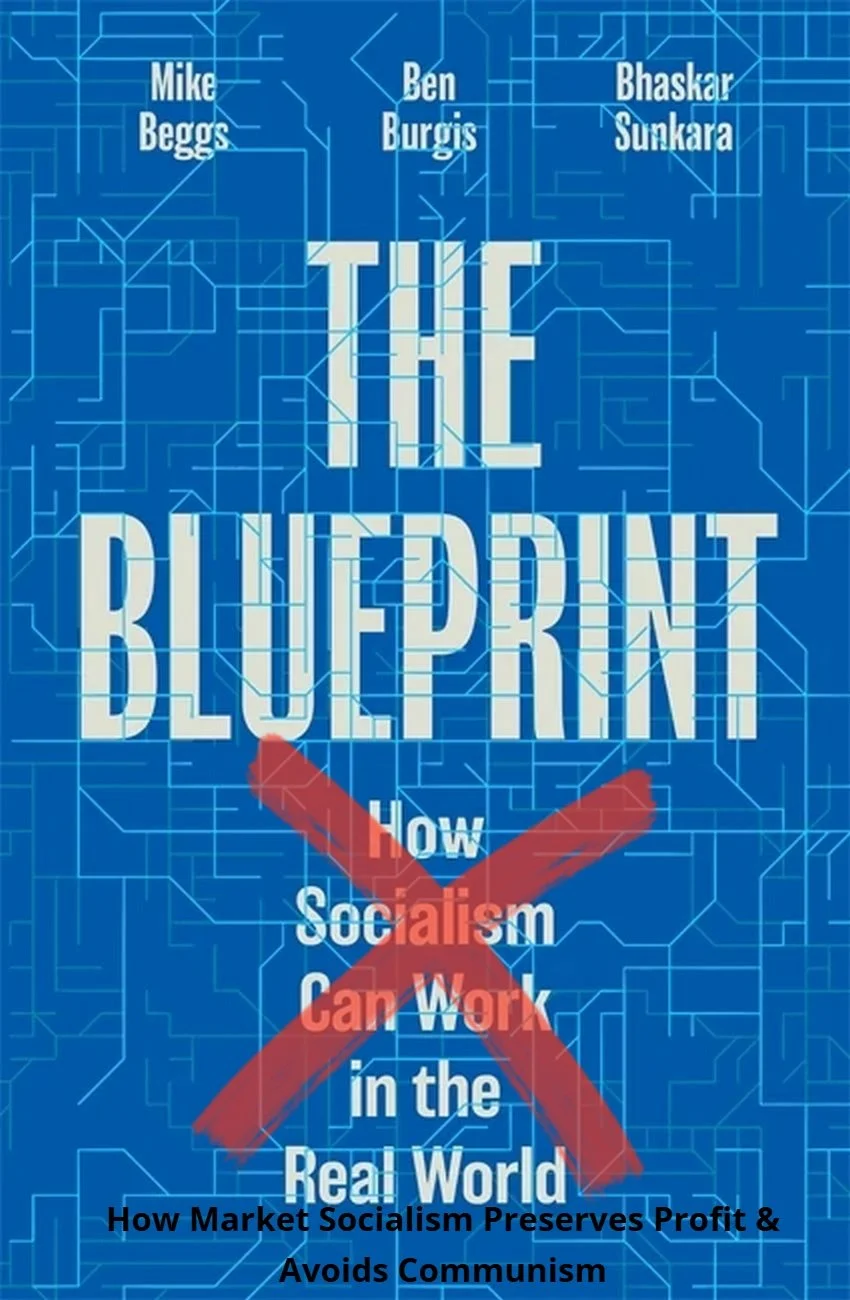
Mike Beggs, Ben Burgis, and Bhaskar Sunkara, The Blueprint: How Socialism Can Work in the Real World. Verso Books, 2026. 424 pages.
_______________________________________________________________________________
The Democratic Socialists of America (DSA) has endorsed and canvassed for a growing list of victorious candidates. But new gain brings new pain, in this case a question: what is DSA’s socialism? Its idea of a socialist economy is expressed in two sentences of its current program: “Establish public ownership of the largest corporations and essential industries to ensure democratic control and accountability to the people. Enact aggressive wealth taxes on the richest individuals and corporations to spend on public goods and infrastructure.” That’s all.
The book at hand, The Blueprint, is very much the opposite. In 424 pages the authors lay out a detailed model of, they claim, a socialist economy. It comes from Bhaskar Sunkara, founder and editorial director of Jacobin magazine, past co-chair of DSA, and president of The Nation magazine in charge of its business strategy. He along with Jacobin editor Mike Beggs and columnist Ben Burgis are ardent theorists of market socialism. For convenience, we will refer to author Sunkara in this review.
A Market Socialist Economy
The Blueprint economy is made up of firms, so-called public banks, and the central bank. Everything is soaked with profit.
Firms produce commodities for sale. No one owns a firm. It is an association of employees (“members” in the authors’ terminology). The means of production and working capital are provided by a public bank. The firm aims to make a profit after payments to the bank and suppliers. The profit cannot remain in the firm nor be reinvested in new equipment. It is distributed to the members, not necessarily in equal portions. These dividends are in addition to the wage or salary.
Individuals can get together and launch a new firm. “When a core group of founders come together to apply to a public bank for the initial funding, they will participate in the drafting of a legal operating agreement before they recruit other members. Founders can award themselves a generous share of profits during this initial period to compensate for their efforts.” (315)
The public banks do not take deposits. They borrow all their funds from the central bank. Then the banks negotiate partnerships with firms. For example, “the partner bank owns the equipment, which the firm rents.” (266) The contract between them may specify that “the rental price adjusts with the state of the market.” Like firms, public banks aim to make a profit. “Most banks will be tasked with pursuing high returns consistent with a given level of risk.” (90) The profit goes to the central bank after deducting money to reward bankers: “Those who make the decisions for banks get bonuses based on the extent to which the returns the institution makes across its portfolio exceed what they pay the central bank for funds.” (251)
There are different ways to arrange a market socialist economy. Sunkara is proud of the firm-and-bank blueprint. Without shame, he extends the profit motivation beyond capitalists and executives; workers’ dividends are profit-sharing to the max. On the other hand, there are no capitalist owners of means of production. No private person or group running a firm can reinvest the profits back into this firm or another one. We will come back to this point.
Profit-motivated firms and banks make up the great bulk of the economy. In addition, just as in modern capitalism, there are government agencies and “community agencies … financed through the public purse.” (140) The latter are familiar to us as so-called nonprofit agencies.
How naïve Eugene Debs was to write in 1912, “Capitalism is founded upon production for profit. Socialism is postulated upon production for use.” Yet 900,000 people voted for him for president that year. Production for use means that we work to meet the needs of all. Our needs are not only food, clothing, shelter, healthcare, and some pleasures and comforts. We need to raise everyone’s culture and skills, discovering and creating what liberated human beings can be.
Why Do These Market Socialists Love Profit?
“One of the biggest influences on our model is the work of Jaroslav Vanek … His approach was to model worker-controlled firms using the familiar tools of neoclassical economics.” (180) Neoclassical doctrine worships a subjective concept of value and hunts for the prices that match it. Bourgeois theorists developed these ideas in the latter half of the nineteenth century as a weapon against the labor theory of value taking root in the working class. Sunkara’s view is, “When producers battle with one another for resources, customers, and funds, the price structure that emerges from the interplay of their strategies ensures that resources are allocated efficiently to satisfy people’s wants and needs.” (94)
Neoclassical economists do not really care about people’s wants. They dwell on fine points of consumer preference in order to magnify the problem of matching production and consumption. The Blueprint, for example, talks in half a dozen different places about pasta sauce, curry-flavored versus basil-flavored sauce, etc. Apparently, you cannot build socialism if people cannot find exactly their preferred flavor of bottled pasta sauce in the store. But where do consumer preferences come from? Steve Jobs announced the first iPhone on Jan. 9, 2007. Before that day, people had no idea that they wanted a smartphone.
A socialist society based on conscious planning knows that people need clothing, healthy foods, and so on. It knows the approximate quantities of them. Markets are a subordinate tool available within a planned economy — without telling firms to produce for profit.
The authors enthuse that profit-driven markets “solve coordination problems with astonishing elegance.” (93) Hardly. Every year some capitalist firms write off investments, abandon projects, or just shred a mountain of unsalable goods. For example, Kraft Heinz booked a loss of more than $12 billion one year against revenue of $26 billion. How is that for the maker of Oscar Mayer, Velveeta, Planters and other food products? An analyst explained it was because management put “overwhelming emphasis on taking costs out and improving margins.” Or consider that in 2019, Schlumberger, the dominant provider of oilfield services to the petroleum industry, booked a loss of nearly $12 billion on $8.5 billion of revenue. Where is that “astonishing elegance” of coordinating production to the market?
Is Profit Necessary?
Is profit necessary to get firms to make what is needed? It is only if you ignore the contradiction between class outlooks. Already in capitalism, most workers are not spurred by profit, yet they work. From one side, they work because they fear being fired. “How can workers have a reason to work hard if they do not fear unemployment? Our answer involves workplace democracy and workers as residual claimants on income to their unit.” (129) “Residual income” is a coy name for profit. We will come to democracy later. Sunkara, a successful media entrepreneur, thinks the spurs to work are the carrot of profit or the threat of hunger. He is blind to working-class consciousness of the most elementary sort. Workers work because they respect that someone will use the result, just as they depend on the work of others. Workers take pride in their skill and diligence. They do not want to let coworkers down. And in a society of their own on the communist path, workers work for all the people, not to enrich that damn boss. Politics brings the choice in the class struggle to everyone.
The Communist Party of the Soviet Union had a rule in its early years that a party member could not receive a wage above that of a skilled worker, even if he was a factory manager, professor or engineer. This commitment could spread beyond the Party. Journalist Anna Louise Strong was an editor of Moscow News in the early 1930s. “When Ogonek offered me six hundred rubles salary with extra pay for every article, I scornfully turned it down… Make mine party maximum, three hundred and seventy-five rubles; that covers everything I write. Led by me, the entire staff made the same decision and put it down in a ‘shock-brigade pledge’—never to take more than party maximum. My cherished staff, who had responsible jobs in their own countries, were getting about one-third the pay of translators.” Their pledge went beyond the principle of “to each according to his labor.” It expressed a social ethic of communism: I contribute what I can, and I receive together with all workers.
The Chase for Profit and the Lure of Capitalism
The Blueprint would motivate nearly everyone by profit. However, individual motivation alone does not make an economy capitalist. Individuals do not formally own means of production, nor shares of firms and banks, nor the financial paper created by the public banks. All seems well.
Inevitably, though, profit income stimulates the urge to reinstate capitalist property. Sunkara realizes there is a problem and suggests guardrail regulations. Yet here and there he relaxes barriers against capitalism. For example, public banks could offer “alternatives to deposits … mutual funds, with customer funds pooled and attached to diversified groups of investments in particular firms.” (174) Also, a bank, instead of leasing machinery to a firm, “itself could own the firm’s productive assets, charging a rent that moves with industry conditions—taking on the risks of ownership while allowing the firm to turn a fixed cost into a variable one.” (173) Add agreements under the table and some bribes and, presto, a covert circle of firms and banks are capitalists shuffling profits around and reinvesting them for their own gain.
The Blueprint is “a vision of what should replace it [capitalism]. Not, mind you, what a successor might look like centuries from now … but how an alternative could function in the present.” (2) By advocating profit-driven market socialism, Sunkara largely ignores that many among the deposed capitalists and their families want to restore capitalism. They will cultivate allies in the government, the banks, and the firms. The threat is real. It has happened before.
Nor do we have centuries to dig out the roots of capitalism. Socialism from the beginning is in contested motion: back toward capitalism or forward to communism. We can begin right away to detach consumption from wages, guaranteeing free and equal health care, education, perhaps transportation next. We should qualify everyone for one and then more than one line of skilled work. Conversely, able-bodied people should rotate through stints of the remaining assembly-line labor. We can find ways to sand down the little and not-so-little distinctions between the typical manager and the rest of us. All this is communism. But the authors hate communism.
Anticommunist to the Core
The Blueprint’s history of the Soviet Union repeats tattered smears from the Hoover Institution and other reactionaries. “The Stalinist period, at an inexcusable human cost, saw notable economic gains.” (45) At least Sunkara acknowledges the vital industrial progress. It was not possible when peasants, kept poor and backward for centuries, grew wheat on scattered strips of land. Collective farming was the answer, unless you preferred helping rich peasants (kulaks) to become large-scale capitalist agribusinessmen. Led by the communists, the poor peasants chose collective farms. Sunkara sees only “terror in the countryside, state collectivization, mass famine, crash industrialization, and the command economy.” (37) He repeats the standard lie that “the 1930s Ukrainian famine wouldn’t have happened if Stalin had been worried about whether peasants would vote to reelect him.” (6) Ignore that “in 1932 Soviet crops suffered from an extraordinarily severe combination of infestations from crop diseases and pests."1 And once farming was collectivized, centuries of frequent famine came to an end.
Sunkara talks like Mark Rubio about “Stalin’s bloody terror and totalitarianism.” (68). Careful searches for evidence have refuted the demonizations of Stalin. Then, Sunkara somehow knows, “Khrushchev came to power dreaming of a more humane and prosperous system.” (46) The historical record is that Khrushchev took the Soviet Union off the path to communism. And he told the world’s communists to give up on revolution and confine themselves to legal, electoral activity – just like DSA.
Sunkara hates revolution and the communist path for two reasons, summarized when he writes of “Stalin’s chance to move against both the New Economic Policy and the last vestiges of democracy.” (36) The New Economic Policy (NEP) was a conscious retreat in 1921 that revived peasants’ freedom of trade and consequently a growth of capitalism. The advocates of profit-driven market socialism wish the NEP had gone on forever. “Some version of the New Economic Policy might have soldiered on.” (37) Instead, central planning replaced it. Sunkara says that central planning was wasteful and that it slowly broke down until it collapsed in 1991. This arc of Soviet society is incorrect. Sunkara understates the enormous gains in living standards, culture, and productive power in the 1930s. He overlooks the Soviet defeat of the Nazi German war machine in World War Two, and he skips over the rapid economic recovery in the late 1940s.
In 1956 the Soviet leadership renounced the communist path. The Khrushchev-Brezhnev era was a distinct era of slowly decaying socialism. The Soviet people never demanded capitalism; Gorbachev and crew finally dismantled the Soviet Union from the top. Gorbachev’s perestroika advocated methods dear to Sunkara: “If someone wants to do lease-contracting, then let him do it; if he wants to form a cooperative, then let him.”
Central Planning
What Sunkara calls central planning was one variation of it, administrative planning used by the Soviet Union. The government plan assigned production tasks to firms and directed the outputs to other firms or to shops. The planning agency and firms consulted so that the plan was brought into balance, firms and shops receiving what they needed. It was a plan to expand productive power and satisfy people’s needs. Therefore, it was a political document. Workers met in the firms to discuss drafts, and people wrote about them in the press. The plan was revised and adopted.
In the ten years before World War Two, administrative planning created basic steel capacity, a railroad network, a machine-tool industry, and tractor factories. We would expect that the planning process would need to evolve later. But after Khrushchev, the Brezhnev regime stagnated without a grand vision.
The key to central planning is overall allocation of investment to meet social goals. In a capitalist economy, the different capitalists chase after their own profit. Each decides if and where to invest his profits (capital accumulation). Sunkara’s market socialism, just like capitalism, “does not involve the comprehensive central direction of economic activity … Worker-controlled firms choose what to produce and how, subject to their ability to at least break even and to finance their operations.” (184; emphasis added)
Central planning does not allow profit. There are different ways to plan overall allocation of investment. You can still have firms selling into markets, but the aim of each firm is to break even. There is no profit because firms must make two payments for every hour of labor time they use: the worker’s wage, and a tax at a rate large enough that, over the entire economy, it collects what would be the surplus value in capitalism. If a firm happens to make a profit, it goes to the government. If a loss, the government covers the shortfall and may reorganize the industry.2
Sunkara embraces profit as the driver of market-socialist economy. Its political counterpart is a non-class concept of democracy.
Parliamentary Democracy
The words “democracy,” “democratic,” and “democratically” occur more than 400 times in The Blueprint. Firms are almost always called “democratic firms.” “Democratic” becomes an empty slogan. Sunkara would have the firms use the parliamentary method of government developed by the bourgeoisie over the last 800 years, “representative democracy, with elected directors appointing and monitoring administrators.” (140)
The Blueprint is silent about class struggle in market socialism. Sunkara does recognize class struggle for reforms in capitalism: “Every durable egalitarian breakthrough—universal schooling, the eight-hour day, social insurance, national health services—arrived through public power, wrested free by class struggle.” (184) No, most reforms under capitalism are not durable. They are incomplete; the capitalist class schemes to whittle them down further and convert them into arenas of profit; and they become shrunken heads of what they once were. Then, supposing that market socialism turns the tables, the class enemy uses its political skills and social advantages in an effort to bring back capitalism.
How will Sunkara get from capitalism to market socialism? “We’re advocates not just of a democratic form of socialism but of a democratic road to getting there.” (294) That is delusional and disastrous. No ruling class gives up its class rule because of a democratic movement. Perhaps the closest that socialism came in by vote was Socialist Party leader Salvador Allende’s election as president of Chile, confirmed by congress on Oct. 24, 1970. Allende expropriated the U.S.-owned copper mines without compensation, bought out some local mining and manufacturing industries, and took over large estates for peasant cooperatives to farm. But he did not break up the capitalist state; he did not establish control over the military. A U.S.-backed coup overthrew the Allende government on Sept. 11, 1973. Led by Augusto Pinochet, the military killed Allende and thousands more. Pinochet’s capitalist dictatorship canceled all the moves to socialism.
Sunkara and DSA pledge to get to socialism by electing candidates, by supporting mass nonviolent protest, by constitutional convention – but not by the only way that working people have ever overthrown capitalist and landlord exploitation: revolution.
Not a Solution for DSA’s Dilemma
Many DSA members will reject the market socialism of The Blueprint. They support class struggle, the overthrow of capitalism, and the socialist-communist road. Whether they stay in DSA or not, communists welcome discussion with them at demonstrations and on picket lines.
Although DSA puts socialism in its name, almost nothing about the organization is socialist. Its principal activity is canvassing for reform candidates on their platforms. Its program is a list of progressive and radical-democratic demands. The gap between name and reality becomes a problem as DSA-backed candidates keep winning elections. The power centers of the Democratic Party smear DSA for radical (but non-socialist) measures like abolition of the Senate. More people ask, “DSA, what is your socialism?”
DSA has finessed the question so far. However, some of its prominent ideologists have an answer. Sunkara’s The Blueprint lays out a “socialism” that relies on profit motivation, botches economic history, glorifies democracy drained of class awareness, and assures everyone that the authors are as anticommunist as any reactionary.
Charles Andrews is the author of The Hollow Colossus and other books.
A list of his essays is at http://www.hollowcolossus.com/moreCA.htm
Rodney Green is a widely published economics professor and serves as associate director of the Howard University Center of Excellence in Housing and Urban Research and Policy. He has been active in the communist movement for over 50 years as a member of the Progressive Labor Party.
________________________________________________________________________________
Mark Tauger, National Disaster and Human Action in the Soviet Famine of 1931-1933. Tauger studied Russian and Soviet agriculture for 25 years of a distinguished academic career
See this reviewer’s No Rich, No Poor for more on central planning.