Browderism: A Reckoning with Our History
PART I: Short History of the CPUSA (1919 – 1932)
EARLY STAGES OF ORGANIZATION (1919 – 1921)
The Communist Party of the USA formed from the split of the Socialist Party (SP), the US section of the Second International. This process was sparked mainly by the outbreak of the imperialist WW1 and the subsequent division of the SP into two camps: social chauvinism and a revolutionary wing opposed to imperialist war. The process reflected the ideological bankruptcy that permeated the parties of the Second International and came to a head in 1919, after nearly two decades of struggle between its revolutionary left wing and reformist right wing. While the left sought to transform the SP into a fighting organization of the working class, the right was committed to parliamentary reforms. The outbreak of WWI, the October Revolution of 1917, and the establishment of the Third (Communist) International or Comintern (CI) convinced the left that a Communist Party (CP) was necessary. Central issues in this process included how the war was characterized, international affiliation—with the left supporting the CI and the right seeking to revive the Second International—and the need for a revolutionary program capable of leading the 1919 strikes.
The consolidation of the left wing was aided not only by Lenin's writings—including A Letter to American Workers, The Soviets at Work, State and Revolution, and Imperialism, the Highest Stage of Capitalism—but also by the work of Sen Katayama, Leon Trotsky, Nikolai Bukharin, and Alexandra Kollontai, who met with Ludwig Lore at their first meeting in Brooklyn on January 14, 1917. Bukharin, Kollontai, and Trotsky remained in the US until returning to Russia in the spring of 1917. Katayama, for his part, devoted immense effort to this process. The movement to transform the SP drew its greatest strength from New York, Ohio, Michigan, Illinois, and Massachusetts, especially among the language federations. Charles E. Ruthenberg and John Reed emerged as the principal leaders of the revolutionary wing.
Although the left wing won increasing support, the right wing retained control of the SP. After the SP refused to censure its own councilmen for supporting the war, representatives of the left met in New York on February 15, 1919, to organize the Left-Wing Section, adopt the Left-Wing Manifesto, elect officers, and establish the New York Communist, edited by Reed. The Manifesto became a beacon for the emerging revolutionary movement.
The Left won overwhelming victories in the SP’s national elections during the spring of 1919, but the right, led by Morris Hillquit, concealed the results, transferred the property of the party to a small corporation under its control, and carried out mass expulsions to prevent the Left from leadership. In response, a national Left-Wing Conference convened in New York on June 21, 1919. Here, big differences emerged. One tendency, represented mainly by the Michigan organization, argued that the SP was a lost cause and that an independent CP should be established immediately. The opposing tendency, led by Reed, Ruthenberg, Alfred Wagenknecht, Alexander Bittelman, W. W. Weinstone, and others, argued that the Left should continue fighting for control of the SP until the national convention of August 30th, where it could win the support of the rank-and-file while exposing the right-wing leadership.
The June conference rejected immediate separation and instead adopted a tactical line aimed at an August 30th capture of the SP at its convention by 1) adopting the Left-Wing Manifesto, 2) affiliating with the CI, 3) accepting the results of the Party elections, and 4) restoring the expelled organizations. Should the right-wing maintain its control, the conference declared that a CP would be immediately organized.
Events quickly showed the bankruptcy of these plans. The Michigan group refused to accept the conference's decision and continued preparations to establish a CP on September 1 in Chicago. Ruthenberg later abandoned his earlier position and joined the Michigan group. Reed-Wagenknecht refused to follow this course and remained committed to contesting control of the SP. The communist movement thus entered a decisive moment. These divisions produced the formation of two communist parties.
After being expelled from the SP convention on August 30, 1919, just one day later, the Reed-Wagenknecht group founded the Communist Labor Party (CLP). True to its plans, the Michigan group organized the Communist Party of America (CPA), the larger of the two organizations. Both parties also established organizations in Canada and remained divided until their eventual underground unification in 1921.
Although the two parties possessed nearly identical programs regarding the state, imperialism, war, and the dictatorship of the proletariat, they differed in their orientations towards the trade unions and shared several weaknesses. The debates reflected that neither party had fully absorbed the fundamentals of Marxism-Leninism nor the lessons of the experiences of Lenin and the Bolsheviks in the October Revolution. As a result, both struggled to correctly analyze the position of Black people in the US, define the role of the CP in elections, develop a sound alliance policy, carry out the Bolshevization of the Party, identify revolutionary situations, accurately assess the development of US capitalism, and gauge the mood of the working class. Many leading figures in the early and unified CP came from the SP, the Industrial Workers of the World (IWW), or the Socialist Labor Party (SLP) and were influenced by Daniel De Leon and his positions that furnished syndicalist and dual-unionist tendencies that were carried into the founding of the CPUSA.
The parties were born during sharp political-economic struggles, placing them in the crosshairs of the post-war offensive of the bourgeoisie, known as the First Red Scare. Domestically, the US economy was experiencing severe difficulties in its transition from wartime to peacetime production, leading to a sharp decline in exports and industrial production while leaving many unemployed. In response, employers began slashing wages and intensifying their assault on unions. At the same time, the US emerged from WWI as the leading capitalist power, pursuing enormous capitalist expansion and an aggressive imperialist policy through its intervention in Latin America, the Dawes and Young Plans, the Nine-Power Treaty, and the Open Door Policy in China. Yet, the rise of US imperialism was threatened by the growing revolutionary wave in Europe and the October Revolution. Consequently, the US bourgeoisie sought to cut the heart of Bolshevism out of the burgeoning labor movement and communist forces. Open-shop campaigns, company unionism, and the National Open Shop Association, with its “American plan”, became important weapons in the employers' offensive against organized labor.
The terror of the ruling class reached its height during the 1920 Palmer Raids when the Department of Justice carried out raids in 70 cities, arresting more than 10,000 people, imprisoning many communist leaders, and deporting numerous foreign-born communists. The Department of Labor supported the repression by declaring CP membership grounds for deportation. The headquarters of the parties were forced to close, and the Party reorganized under conditions of illegality. Facing repression, much of the two parties’ activities continued through the publication of newspapers, pamphlets, books, work in the language federations, and Workers Councils.
The government crackdown stemmed from one of the greatest strike waves in US history. In 1919, more than 4 million workers went on strike, including the famous steel and coal strikes, while roughly 10 million participated in strikes between 1919 and 1922. Employers responded with wage cuts, intensified exploitation, police violence, court trials, spies, and strikebreaking. Although workers fought militant battles and won concessions, many struggles were ultimately defeated. During this period, the communist movement was too young and internally divided to provide effective leadership. Still struggling to achieve unity and consolidate its own ideological formation, it remained isolated from the labor movement in the years 1919-1920.
Recognizing these weaknesses, leaders of both CPs gradually moved toward unity, spurred by the loss of 50,000 members because of the Palmer Raids. The CLP pressed for unity, but the CPA was reluctant. Ruthenberg became one of the main advocates of unity, winning over the Bittelman-led Jewish Federation to the CLP. The unification process was tense and threatened to abort the prospect of a CP. The CPA claimed the CLP were opportunists and centrists, that the foreign-born were more revolutionary, and that the federations were a powerful means of organizing foreign-born workers. In essence, the arguments and structure of the CPA mirrored those of the Bund to which Lenin had already answered in 1903. The immaturity of the process was reflected in the elevation of minor differences into major debates and disparaging remarks.
Only the CI's second intervention, backed by a letter from the Enlarged Executive Committee of the Communist International (ECCI) threatening to deny admission to both organizations after its first appeal was ignored, brought unity. In May 1921, the United Communist Party (UCP) was formed. Once united, the UCP, with the guidance provided by the ECCI, declared the federations “too loose” and started bringing their activities under the supervision of the Central Committee (CC). The CI’s Second Congress (July 1920) adopted the 21 Conditions of Admission to the CI, establishing the general organizational principles for all CPs. These points were never officially endorsed by the two US parties, even after their unity. The 21 points presented by Lenin were also a direct response to positions that conceived Bolshevism as uniquely Russian. It showed that it had universal relevance which could not be superseded by any national peculiarities. Further, the 21 points aimed to purge the centrist and opportunist elements from the CI and its member parties.
The final unity convention of May 1921 was held in New York, where delegates abandoned “dual unionism” (a vestige of the socialist parties and syndicalist tendencies), debated the role of the language federations, and completed the fusion of the remaining organizations into a single Communist Party of America (CPA) with headquarters in New York. Ruthenberg was elected Executive Secretary.
FROM ISOLATION TO LEGALITY AND WORK IN THE TRADE UNIONS (1921 – 1923)
Following unification, the CPA sought to strengthen itself by recruiting militants from other political groupings and developing closer ties to the working class. Following the debates within the Comintern between 1920 and 1921 (i.e., Reed and Karl Radek) and the formation of the Red International of Labor Unions (RILU), which clarified both the CPA's and the CI’s orientation toward the IWW, the CPA appealed to IWW members. It criticized the IWW's syndicalism while recognizing its revolutionary traditions, including its support for the October Revolution and the Third International—which it had originally sought to join—despite its mistaken attitude toward the necessity of a revolutionary workers’ party. The Party continued activities within the IWW until at least 1928. The campaign succeeded in winning nearly 2,000 members, including William "Big Bill" Haywood, George Hardy, Roy Brown, and, in the mid-1920s, Elizabeth Gurley Flynn. The Party also expanded its influence among Black revolutionaries, youth, and several prominent communist women—including Ella Reeve Bloor, Anita Whitney, Rose Pastor Stokes, Margaret Krumbein, Rose Baron, Becky Buhay, and others, all of whom played important roles in the Party's development. It was during this period, in 1921, that Browder first entered the ranks of the Party, having previously worked closely with James P. Cannon in Kansas.
One of the Party's greatest advances was its work carried out through the Trade Union Educational League (TUEL), founded in Chicago by William Z. Foster in November 1920. TUEL became a principal means by which the CPA expressed its trade union work and rooted itself within the working class from late 1921 to early 1922. Foster and other TUEL militants joined the CPA in 1921 after TUEL affiliated with the RILU, creating an organic connection between the Party and the organized labor movement, particularly the Chicago Federation of Labor. After being assigned as a delegate to the RILU on Cannon's recommendation, Browder recruited Foster to join the RILU. TUEL concentrated its efforts on three main objectives: the amalgamation of craft unions and industrial unions, the creation of an independent labor party, and recognition of the Soviet Union. It opposed the union bureaucracy and the class collaborationism of the leadership of the American Federation of Labor (AFL), notably Samuel Gompers (Gomperism), by building a rank-and-file movement and aimed to organize millions of unorganized workers. Factions were built within existing unions and became an important force in numerous strikes throughout the Midwest. In 1923, this movement faced severe resistance from the AFL leadership and the forces of social democracy that united with Gompers to root out communist influence and defeat efforts toward industrial unionism. The enforced isolation from the trade unions catalyzed the intense struggle within the Party.
The Party entered a period of crucial debates, particularly over illegal-legal work. Among the nascent communist forces, there still existed tendencies skeptical of the Leninist party and its methods of organization. One major example was the Finnish Socialist Federation that preferred legal work. In its efforts to unite all these forces, the CPA attempted to legalize itself during a period of intense political reaction and repression. The wave of repression encouraged many to accept permanent underground status, leading to a belief that the CP in a capitalist country could only operate illegally. Thus, the CPA raised obstacles for itself by remaining isolated from the daily struggles of the working class and resigning itself mainly to propaganda.
The Workers Party of America (WPA), with Cannon at the head, was formed in December 1921 to begin legal communist work while the CPA continued clandestine work. This marked the conclusion of the Party’s founding period, leading to the unification of several communist groupings. Contrary to claims that the CI played a negative role in the US communist movement, it was instrumental in establishing and organizing the Party.
Within the newly formed WPA, weaknesses survived, and splits continued, forcing the intervention of the CI on various occasions. Among its political weaknesses, the WPA retained the conception of the need for a minimum-maximum program, inherited from the Bolsheviks in 1905 when imperialism had not yet consolidated. This conception reflected the thesis of the democratic revolution. Lenin's April Theses of 1917, drafted in the period when imperialism had already consolidated, demonstrated that, in the era of imperialism, the program of the communists must include the necessity of the socialist revolution rather than the theory of stages or intermediate phases between capitalism and socialism: the subject of the minimum program. Once more, it was illustrated that communists in the US had not fully assimilated the lessons of the victory of the October Revolution.
The formation of the WPA was considered necessary in conditions of repression, but its existence was the subject of a serious split. Members of the Central Executive Committee (CEC), also known as the Central Caucus – Charles Dirba, George Ashkenudzie, and John Ballam – argued that forming the WPA amounted to liquidating the CP and insisted that revolutionary work should remain entirely underground. Splitting off, they formed the United Toilers of America and published The Workers Challenge. In April 1922, the CI endorsed building the legal party with the members of the underground section as its most active elements and opposed the split. By August 1922, the United Toilers dissolved, and its members returned to the CPA. However, the split raised the important question of the Party's all-weather character, reflecting similar debates that occurred when the Bolsheviks clarified the nature of the Leninist party in the debates against the Otzovists and Liquidators.
At the same time, under the advice of the CI, efforts were made to end the factionalism that plagued the Party. According to the CEC, factionalism, which had temporarily subsided, was intensifying again as a result of the "application of the policies of the 3rd Congress of the Communist International," reawakening "the factional spirit" within the Party. On the CI's instructions, the Party convention was postponed, and the CEC was reorganized to promote unity. Weinstone, Zack, and Lunin voluntarily resigned, while Wagenknecht, Minor, and Browder were co-opted to "draw into the committee additional elements which can contribute to the unification of the Party."
It was in this context that Browder first entered the Party leadership. He immediately proposed reorganizing the CEC by creating Industrial, Political, and Organizational committees, requiring each to share information, maintain records, and remain accountable to the entire CEC. Before this, Browder had worked closely with Cannon and Foster and, as later voting records would show, was almost always aligned with Foster's faction.
In a letter written to the CPA by Zinoviev on October 9, 1921, speaking on behalf of the CI, a response was given to those who believed all work should be illegal:
“It is necessary to create a legal ‘Society of Friends of Labor’, or something of the sort…but a society acting openly, which would provide the possibility of raising your head from the underground…”.
Despite Zinoviev's and the ECCI's June 1920 letters highlighting the necessity of illegal work, the question was debated again at the illegal Michigan Convention in 1922, where the continuation of underground work was reaffirmed and Browder, who had already been co-opted into the leadership, was elected a full member of the CEC. Here, two factions arose: the ‘geese’ (“Goose Caucus”) and the ‘liquidators’, whose names derive from insults thrown at each other. Around the ‘geese’ were grouped those who argued for keeping the illegal party in charge of the legal work, while the ‘liquidators’ argued to legalize the party and abolish underground work. The ‘geese’ had their center in the language federations, and the ‘liquidators’ were based within the native US cadre led by Cannon, Jay Lovestone, Ruthenberg, and Foster. Both sides contained elements of truth leading to a compromise resolution where open work was considered the main task of the Party, yet the illegal apparatus would continue to direct the whole of the CP’s activities.
The internationalism of the CI was illustrated through the role of its representatives at this convention: Henryk Valetski, Joseph Pogany, and Boris Reinstein. Together, they prevented further unnecessary splits, safeguarded the unity of the Party, and outlined the intense interpersonal struggles that accompanied the debates between the ‘left’ and ‘right’ oppositions within the US communist forces. These debates already contained the seeds of later exaggerations of US conditions and mechanical attempts to apply the Russian experience to the US. Of course, the historical, cultural, economic, and political features of each country must be considered during the struggle for socialist revolution, as evidenced by the historical experiences of Russia and Cuba. While the form adopted by socialist revolution can differ in each national context, what remains essential is that the content of overthrowing the capitalist system in the era of imperialism is the same worldwide.
The dispute that began in the Michigan conference was carried to the Fourth Congress of the CI (November 7 – December 3, 1922), where the American Commission ruled that:
The legal and illegal party organizations are combined, including their respective Executive Committees
The illegal party would continue within the legal party as “an apparatus for necessary illegal work” and protecting the party against attacks.
The WP becomes the American section of the CI, acknowledged only as a sympathetic party but with the rights and privileges of the other sections of the CI.
All members of the WPA are subject to the discipline of the CI.
Work in the left-wing of trade unions is necessary.
The WP must cultivate the feelings for a Labor Party which would mark the birth of US workers as a class.
Almost as an answer to the question facing the Party, shortly after the Michigan convention, the FBI raided and arrested the CP leadership, initiating a long legal struggle over the Party's open work. However, over time, the political situation began to change, with the state employing less violent methods. In this climate, on April 7, 1923, the CPA and the WPA merged, ending 29 months of underground existence and establishing a fully public presence.
The WPA was a major step to break free from the isolation of 1919–1920. It made significant progress with its work in the trade unions, the struggles of Black people, women, and youth. The years 1922–1923 also witnessed the WPA’s growing intervention in broader political and labor struggles. Through organizations such as the Labor Defense Council, Communists defended the 57 Party leaders arrested during the 1922 Michigan raids, laying the foundation for later organizations such as the International Labor Defense, established in 1925. The WPA was also at the heart of the fight to save Sacco and Vanzetti. These developments proved that the Party was struggling to emerge from isolation and secure its existence.
THE PARTY IN THE COOLIDGE ERA (1923–1929)
Between 1922 and 1924, the Party advocated the formation of an independent Labor Party, arguing that political development in the US differed from Europe. The primary difference was the development of the trade unions before the organization of political parties. The farmer-labor movement led, in 1923, to the formation of Farmer-Labor parties in various states, with the decisive influence of the WPA.
Therefore, the WPA sought to unite all labor parties, unions, groups, and later farmers into an independent political movement through the Labor Party (1922), the Federated Farmer-Labor Party (1923), and the Farmer-Labor Party (1924). The debates surrounding the formation of a labor party developed into yet another factional struggle that dominated the Party between 1923-1929. Two principal groupings emerged around Foster-Cannon-Bittelman and Ruthenberg-Pepper-Lovestone. Both acted as two separate parties. Although centered initially on the policy of forming a Labor Party, the debates increasingly expanded into questions concerning Party organization, trade union work, and the character of US capitalism.
The origin of the Labor Party was the Chicago Federation of Labor, led by John Fitzpatrick, a colleague of Foster. Fitzpatrick helped organize the Chicago Labor Party in 1920, which sought electoral representation but was nevertheless opposed by the SP and the rising Progressive Party movement. Afterwards, it attempted to add “Farmer” to its name to capture the indignation of farmers and even attempted to unite with the third-party movement developing around Robert La Follette, who refused on the basis that the Farmer-Labor Party (FLP) was socialist.
The essence of the Labor Party is best outlined by TUEL in its organ, The Labor Herald:
“The Labor Party must be definitely rooted in the economic needs of the workers; it must be a party of the working class, yet it must be broad and inclusive enough to take in all the various political parties and groupings of Labor”
Further:
“The conflict of ideas, certain to come from contact with each other by definite groups within such a Party, will be the most positive guarantee against stagnation and sterility. The health of the Labor Party demands that unions, groups, and parties entering into the federated Labor Party shall continue their own organization, identity, press, etc.”
While the Labor Party advanced anti-capitalist and anti-monopolist aims, even asserting the necessity of workers' power, its justification as an application of the united front policy was confused and erroneous. It called into question the independence and autonomy of the CP: the organizer and leading force of the revolutionary process, the vanguard and the party of the working class. Numerous parties claiming to represent the interests of the working class, regardless of how they describe themselves, cannot simultaneously fulfill this role. Although the CP is not the only force that helps create subjective conditions for revolution, it is the decisive subjective factor and has no substitute. The search for fronts, alliances, or movements capable of producing change by placing leadership in such formations while reducing the Party to merely one force among many, even sacrificing its leading position for the sake of unity, cannot be the path taken by the vanguard of the revolutionary working class.
In the 1924 presidential elections, the representative of the Progressive Party, La Follette, was at the head of the farmer-labor movement. His presidential run was one of the most successful third-party campaigns in US history. At that time, most of the Party leadership advocated supporting La Follette, believing that doing so would weaken the stranglehold of the two-party system, accelerate the class struggle, and undermine the united anti-worker policies of the two bourgeois parties. Interestingly, Reed had already, in 1919, compared the Progressive Party to the Constitutional Democrats (Cadets) in Ten Days That Shook the World, characterizing it as a party of reforms. According to Cannon, in response to opponents of the policy, a Labor Party would arise from the third-party movement, and an alliance with it was justified by the Comintern's directives to the Communist Party of Mexico to endorse and defend the government of General Plutarco Elías Calles.
Of those opposing La Follette were Olgin and Lore, not without their own illusions, claiming that it was impossible to have a common campaign with “a third bourgeois party for its bourgeois candidates” while conducting an independent campaign for the Program of the WPA. Lore would later become the subject of an intense debate and anti-Trotskyist fight within the Party at the direction of the CI.
The conclusions of the Fifth Congress of the CI (June 17 to July 8, 1924) correctly assessed the petty-bourgeois character of the La Follette Movement and its role as a capitalist safety valve which, with the help of Gompers, was channeling rising working-class consciousness back into the needs of capital and preventing the consolidation of an independent workers' movement. Nevertheless, illusions were fostered about the effectiveness of a third-party movement. Further, the Party did not provide a class analysis of this farmer-labor movement. Characteristic of the conciliatory and reformist positions that existed within the Party were those of Pepper, who believed the La Follette Movement represented a “third revolution”.
Despite La Follette’s anti-communism and isolation of the communists from election campaigns, Foster, in his History of the Communist Party of the United States (1952), criticized the Party's withdrawal from the La Follette Movement as a sectarian mistake. Foster, with Cannon, was among the supporters of La Follette, although differing on the tactical application of the formation of the Labor Party and even adopting positions from and entering a bloc with Olgin-Lore. Foster, fearing further isolation of the Party in the context of AFL exclusions, saw the third-party movement as a venue for splitting off the union-labor forces and advancing a program of demands. Further, Foster-Cannon viewed the movement as a revolt against big capital but, with the failure to make headway, did not agree with the policy of trying to form a Labor Party following the British model. Instead, they advanced the belief that the Labor Party needed to be built up from within the trade unions. The position of Ruthenberg-Pepper, working within La Follette’s Movement for the Farmer-Labor Party and in disagreement with a strictly union-based approach, was supported by the ECCI.
However, when the CI intervened, it instructed the WPA to abandon the slogan “Farmer-Labor Party” for a “Labor Party” only. The Resolution on the American Question, adopted by the ECCI and published on June 4, 1925, refined the Party’s tactics in forming a Labor Party. It presented the formation of such a party as a step forward in the labor movement and a training ground where workers would experience the "beginning of their political emancipation and the development of class consciousness”. The WPA was directed to agitate for a Labor Party only since the possibility of communists being in the lead at first was considered a view “too narrow”. The Party was obliged to participate actively in its formation to remain in the "closest contact with the masses", to drive a wedge in the La Follette Movement using consistent exposure of La Follette’s servility to capitalist interests, and at the appropriate moment, win the most advanced and revolutionary elements into the WPA.
The efforts to form a Labor Party ultimately failed. La Follette, winning nomination of the Conference for Progressive Political Action (CPPA) – an organization of many anti-communist and reactionary union leaders like Gompers – was able to draw on the anti-communist sympathies within the Minnesota FLP, further isolating and marginalizing the communists. In response, the WPA correctly ran its own candidate, Foster, in the 1924 elections. This would be the first Communist ticket to appear in a national election, receiving approximately 33,000 votes in 13 states. La Follette’s defeat led to the dissolution of the CPPA and reinforced the concept of political neutrality pushed by Gompers.
This complex process ultimately demonstrated that the communists appeared to be caught up in the distortion and confusion surrounding social democracy shared by a section of parties and members of the Comintern.
Throughout his recollection of the history of the CPUSA, Foster emphasizes “specific American conditions”. In the chapter “The Working Class and Socialism”, these conditions called forth the need for “special adaptations and special American forms and applications of the people’s democracy and its slogans”. One example cited is the Farmer-Labor Party. Here, the continued influence of the theory of stages is reflected: the belief in an intermediate form of government between capitalism and socialism. This issue surfaced frequently throughout the history of the communist movement in the US. Whatever national specificities existed did not negate the fact that the communists in the US were living in the era of monopoly capitalism, of imperialism, in which the bourgeois state, as the collective capitalist, expresses the power of the monopolies. No specific national conditions could alter the fundamental principle of the necessity of the CP and its historic mission for the overthrow of capitalism – the socialist revolution – then or now.
While it is understandable that the WPA was attempting to intervene within the workers’ and people’s movements and forge its policy of alliances, this process delayed the strengthening of the Party and cultivated illusions surrounding bourgeois democracy, the bourgeois state, strengthened opportunist reformist forces, and obscured the confrontations between different segments of the US ruling class. It placed an obstacle in the path of deepening the ideological-political level development of the CP. Throughout its history, our Party sought to build alliances within various political movements, parties, or organizations that emerged from the development of the class struggle. Many of these movements were characterized by multiple political tendencies and class forces and became arenas of activity that ultimately postponed the necessity of the socialist revolution and the strengthening of its subjective factor. The consistent development of the CP’s independent revolutionary line and its ability to rally the principal social forces necessary for a confrontation with the capitalist system was hindered. The erroneous and contradictory perceptions, in many cases, were derived not from the dominance of the capitalist relations of production, but from the level of development of the productive forces as expressed in the so-called specific “American conditions”.
A revealing example of this can be found in Party Principles and Discipline: A Letter Authorized by the Central Executive Committee Directing the Reinstatement of an Expelled Comrade. Written by Ruthenberg and endorsed by the CEC, the letter addressed the case of Otto Newman, who had been expelled by the Local English branch in Oregon for advocating the forcible overthrow of the government after being instructed not to do so. In reality, Newman was reading from CI documents, and after investigating the matter, the CEC found no wrongdoing, ordered his reinstatement, and clarified the Party's position on violence. While the episode itself reflects the erroneous conceptions of what a CP is and should be—a party of revolution—which existed within the Party, what is most significant here is the CEC's clarification. The letter stated that the Party "does not advocate the use of force by the workers today" and that its efforts were instead directed toward building a mass political party, the Farmer-Labor Party, through which the "cause of the revolutionary movement in the US can be best served." Rather than focusing on building the decisive subjective factor—the CP itself—the WPA concentrated on building a Labor Party, a project that ultimately failed.
These weaknesses also reflected the situation of the international communist movement (ICM) in the 1920s. More broadly, the ICM failed to develop a consistent and unified assessment of social democracy, was entangled in factional struggles, and witnessed the strengthening of right-opportunism in response to confrontation with ultra-left currents. Consequently, the ideological-political struggle against social democracy weakened. In turn, conceptions emerged that treated sections of social democracy as potential allies by dividing it into "progressive" and right wings. One important consequence of this development was the problematic approach to intra-bourgeois and inter-imperialist contradictions, an issue that would reappear during WWII in the conception that characterized that imperialist war primarily as an anti-fascist war, a position later taken up in the theories of Browder. In this context, La Follette's advisers, most prominently Harold Ickes, later joined the administration of Franklin D. Roosevelt and played important roles in implementing the New Deal. For the CPUSA, this marked another period in which it was not free from political illusions, shaped by the framework and line of the anti-fascist alliance.
The factional disputes that drowned the Party took place in the period of capitalist stabilization under the administration of Calvin Coolidge. Between 1923 and 1929, capitalism in the US experienced rapid industrial expansion and increasing military expenditures. The US imperialist interventions in Central America and the Caribbean were coordinated along with its intensified hostility toward the Soviet Union. The employers accelerated production, promoted company unionism, and collaborated closely with the yellow unions to suppress militancy. The AFL leadership embraced a policy of class collaboration, supporting the speed-ups and productivity push of the employers while fostering the illusion that workers and capitalists shared common interests. Labor banks, promises of "everlasting prosperity," and the ideology of class cooperation all reinforced the erroneous theory of “American exceptionalism” within the Party by its principal figure, Lovestone. It was the belief that capitalism in the US had overcome the contradictions affecting the rest of the capitalist world. Despite the belief in social progress in this period, “prosperity” was reserved for the monopolies that reaped exorbitant profits from intensified exploitation. The Coolidge period corresponded with what Lenin described as occurring with the development of the monopoly stage of capitalism, imperialism: the intensification of opportunism.
Union membership declined, hard-won labor rights were rolled back, wages remained suppressed despite rising productivity, and employer terrorism became widespread. Communists and TUEL militants were frequently expelled from unions, dismissed from employment, or physically attacked by employers, police, organized crime, and union leaders. The SP leaders within the unions contributed to the removal and marginalization of the communists. Many unions amended their constitutions to prohibit communist membership, while the SP consistently aligned itself with AFL leadership against communist influence. The results of the splits between pro-La Follette forces and the communist influenced, class-oriented forces within the union played a role in these expulsions. Hindered by incessant factionalism, the Party was unable in the mid-1920s to root itself in the struggles of the workers.
Despite these setbacks, the newly named Workers (Communist) Party (W(C)P) expanded its influence through its participation in major labor struggles in the late-1920s. TUEL remained its principal vehicle for work inside existing unions. The leading role of the communists, displayed during the Passaic textile strike of 1926 and the New Bedford cotton strike of 1928, signaled the emergence of a new revolutionary force within the US labor movement. The communists exposed the failure of the “no-strike” policy of the AFL leadership that could not lead workers, while expanding the Party’s influence among textile workers throughout New Jersey, New England, Tennessee, Georgia, and the Carolinas.
The widespread expulsion of communists from AFL unions, combined with the limits of craft unionism, led the Party to reorganize its trade union policy in 1929 by replacing the TUEL with the Trade Union Unity League (TUUL). This was a necessary response to changing conditions, in which communists and class-oriented trade unionism had to adapt to a situation where, while continuing to work within the existing unions where possible, they also had to adopt new methods of struggle outside of and against the reformist unions that left millions of workers unorganized while isolating and expelling communists. This was highlighted by Losovsky during the debates of the Trade Union Commission of the ECCI, where he emphasized the need for new unions. The RILU also demonstrated that the betrayal of the social democratic labor leaders (the SP in the US) internationally required the development of independent revolutionary unionism.
Whereas TUEL had focused primarily on the existing unions, the TUUL expanded its work to include concentrated efforts to organize unorganized workers. It was a necessary response not only to the mass expulsions, but also to the AFL's declining influence in various industries and its relevance primarily to skilled workers. Under these conditions, the question of independent unionism surfaced, calling for the organization of new unions among workers in the unorganized and semi-organized industries. TUUL began laying the foundation for the major industrial organizing drives of the mid-1930s. Not all Party leaders agreed with this new path. Lovestone opposed the new trade union policy.
Alongside its trade union work and following its IV Convention in 1925, the W(C)P began the process of Bolshevization by shifting organization away from the semi-autonomous language federations toward shop nuclei (workplace cells). The federated structure had severely inhibited the work of the Party and came under increasing criticism from the CI. The outcome of such a structure was that members of two federations could work in the same factory or trade union but could not coordinate political activity. It was estimated that in 1923 only 7.6% of the membership were in English-language branches. The composition of the English branches roughly reflected the influence among native workers. The most significant and influential was the Finnish federation, which split over the necessity of the Bolshevization of the Party.
As part of this reorganization, increasing emphasis was placed on concentration in the basic industries: mining, maritime transport, chemicals, and heavy industry. However, by 1928, only 10% of the Party membership was rooted in workplaces, and language federations still existed. By 1929, the Party published around 25 shop newspapers. On the ideological-educational front, the Workers School had been founded in 1923. The Party also relocated its headquarters from Chicago to New York in 1927.
The W(C)P also expanded its work among women, youth, and Black people. The National Women's Commission directed organizing among working women in industry while also conducting activity among housewives. Communist women played leading roles in the textile and needle trades, and the newspaper The Working Woman, founded in 1929, became the Party's main publication directed toward women workers. By the early 1930s, women made up nearly 40% of Party membership. The Young Communist League (YCL), although hampered by the factional struggles in the Party, continued efforts to recruit working youth. The W(C)P made important advances among Black workers through the establishment of the American Negro Labor Congress in 1925, later replaced by the League of Struggle for Negro Rights in 1930. The work among Black people was a significant achievement during the Coolidge period. By 1930, Black membership in the Party had reached approximately 6,000. This, too, originated in Lenin's solicitation of Reed about the situation of Black people in the US and would subsequently become work taken up under the inspiration of the CI.
In the meantime, the internal disputes raging since 1925 intensified, culminating in a crucial struggle over Lovestone's theory of "American exceptionalism." The situation reached a boiling point where a Parity Commission was established under the oversight of the CI, which assigned Sergei Ivanovich Gusev to mediate the dispute between the two rival factions: Lovestone-Pepper-Ruthenberg and Bittelman-Foster-Cannon. Foster and Cannon would split over the conclusion of parity, which resulted in equal representation of both groups in the Party leadership. Following Ruthenberg’s death in 1927, Foster and Cannon would once again form a temporary bloc to prevent Lovestone from gathering forces to shore up the majority leadership amidst the Eighth CI Plenum held in May 1927.
The factions appealed to the American Commission, and a resolution was issued that directed the Party to build a broad united front against US imperialism while recognizing that the relative stability of US capitalism made an immediate revolutionary upsurge unlikely, making the construction of a mass CP the central task. It reaffirmed trade union work as the Party's principal activity, strengthened support for Foster and the Trade Union Educational League (TUEL), and called for expanding communist influence both within and outside the existing unions. To end the Party's factional crisis, the resolution established a parity arrangement between the rival factions, ordered an August convention, and required the liquidation of factionalism through proportional representation and a unified Party leadership. While both accepted the resolution on paper, what followed were statements from both groups which had the result of further inflaming the struggle. For example, the National Opposition Bloc was set up by Foster-Cannon supporters, which was condemned by the CI. In the lead-up to the August Convention, a Party-wide discussion was held within the Daily Worker, and full membership meetings were held in the cities to allow each faction to present their case. Elections were held, and following the August Convention, Lovestone received the most votes.
The struggle between these shifting alliances became one of the principal obstacles to Party development during the late 1920s. Their underlying basis was repeatedly identified by the CI and captured in the Resolution of the Presidium of the ECCI on the American Question, adopted on July 1, 1927, and published in the Daily Worker on August 3. The resolution argued that the Party's limited presence among native-born workers and in the basic industries, together with the resulting weakness of its internal Party life, created favorable conditions for the growth of group and factional struggles. What is striking about these debates is the direct proof they provide that there is no pure expression of opportunism, since all its forms inherently mix right and left deviations, even though the right variant is the dominant form from which the ICM and the Party in the US have historically suffered.
Accordingly, amid the struggle against the general danger of right opportunism, the Sixth Congress of the CI sharply criticized both major factions in the W(C)P for exaggerating the uniqueness of US capitalism, emphasizing that capitalism's apparent stabilization was temporary and that the struggle against both right opportunism and social democracy had to be intensified. The Congress also marked a turning point for Cannon, who sided with Trotsky, leading to his expulsion and subsequent formation of the Communist League of America and its newspaper, The Militant. Cannon afterwards became a principal organizer of Trotskyism in the Americas, helping lay its foundations in Argentina and contributing to the organization of the Fourth International.
In March 1929, at the VI Convention of the W(C)P in New York, the Party was nearly plunged into crisis. The factions were in a stalemate and sought advice from the CI. By this point, the CI had intervened five times to end the factional struggle and correct the distortions of both groups that were in active violation of its decisions. The CI warned that both factions exhibited serious right-wing deviations that departed from its line, creating the danger that an open right deviation would crystallize within the Party. It was concluded that although the theory of "American exceptionalism" found its clearest expression in the majority Lovestone-Pepper faction, it was fundamentally a “lever” of opportunism fostered by the pressures of US imperialism and the predominance of reformist illusions during the period of capitalist stabilization. Lovestone’s group argued that the unique development of capitalism in the US required a distinct strategy and attempted to justify this position with Lenin's theory of uneven capitalist development.
In his speeches on the CPUSA, Stalin emphasized that every CP must recognize the specific characteristics of its own country, but its strategy must ultimately rest upon the universal laws of capitalist development rather than national peculiarities. Accordingly, he identified serious defects in both major factions and warned that the petty, prolonged factionalism between them had become destructive to Party work. Despite directing most of the fire to the Lovestone group, the appeals of the two factions intended to court favor from the CI were ridiculed as “rotten diplomacy”, “diplomatic intrigue”, and guided by “unprincipled factionalism”. Some within the CI even pushed for an entirely new leadership within the US Party.
The CI further maintained that this erroneous theory was not confined to the majority; it also underlies the minority's most significant mistakes, including its failure to decisively break with and combat Trotskyism. As a result, the Party was rendered incapable of effectively struggling against the right deviation within its own ranks. One element of this could be found in the fact that a majority of the VI Convention delegates supported Lovestone. The existence of both groups and its failure to adhere to the decisions of the CI – as the leading center of the world’s CPs, despite its own shortcomings – demonstrated that democratic centralism was virtually nonexistent in the Party.
Lovestone was later revealed to be a collaborator of Bukharin. Bukharin was a right-deviationist who advocated for an extension of the New Economic Policy, stating to the peasantry, "enrich yourselves," and also proposing to achieve socialism "at a snail's pace". Consequently, along with Benjamin Gitlow and their supporters, the Lovestone group rejected the CI's conclusions and attempted to split the Party, leading to their expulsion in 1929. Lovestone would organize the Communist Party of the USA (Majority) with its organ Revolutionary Age and later help form the International Communist Opposition (ICO). Both were subversive and ideologically bankrupt organizations. Eventually, Lovestone would become a vile anti-communist, work for the CIA, and prove useful to the US State Department along with Bertram Wolfe and Gitlow.
With the defeat of Lovestone's right opportunism and the earlier Trotskyist faction led by Cannon, who was expelled with around 100 supporters in 1928, the Party secured a necessary precondition for its consolidation and subsequent growth during the Great Depression. Six years of factional conflict had come to an end. At the same time, these struggles reaffirmed that, regardless of the level of US capitalist development, the universal laws of capitalist development had to remain the foundation of revolutionary strategy.
THE GREAT DEPRESSION AND THE GROWTH OF THE COMMUNIST PARTY (1929 – 1932)
The economic crisis of October 1929, marked by the stock market crash, signaled the end of the period of capitalist stabilization and confirmed the prediction that the apparent “prosperity” was temporary. The crisis decisively refuted the theory of “American exceptionalism”, demonstrating that capitalism in the US followed the general laws of the capitalist mode of production. At the Party's CC meetings in 1928, 1929, and 1930, they warned that the policies pursued during the Coolidge administration were creating the conditions for a severe economic crisis.
The depression rapidly developed into one of the deepest crises in the history of US capitalism. Industrial production fell by nearly 50%, almost 6,000 banks failed, farm prices collapsed, and wages in many industries were cut by as much as 45%. By 1933, approximately 17 million workers were unemployed, while millions more remained only partially employed. The crisis was one of capitalist overproduction, where rapidly expanding production led to a situation where capitalist markets could not absorb the output. The violent effects of the crisis revealed the parasitic and decaying character of the imperialist epoch, as enormous quantities of food and agricultural products were destroyed while millions faced hunger and poverty.
The administration of Herbert Hoover responded by defending the interests of the monopolies and shifting the burden of the crisis onto the workers and people. Hoover transferred relief programs to the authority of the states and private interests, resulting in an inadequate and uneven response across the country. While poverty and homelessness worsened, the Hoover administration demagogically continued to promise that “prosperity” would soon return, even as it supported wage reductions. It bailed out the railways, banks, and industries with state subsidies provided to the Reconstruction Finance Corporation, claiming the subsidies would "trickle down" to workers. Fearful of the growing influence of communism, the administration also deployed armed forces to suppress a rising strike movement, mobilizations of the farmers and veterans, and demonstrations by the unemployed.
Under its new name—the Communist Party of the United States—the Party sought to transform the economic crisis into a period of intensified class struggle. Throughout the late 1920s and early 1930s, the Communists proved themselves to be ardent fighters for the working class, playing an important role in organizing unions and winning leadership within them. Some of these unions, including the Automobile Workers' Union (AWU), go on to affiliate with the Party's newly organized trade union body, the Trade Union Unity League (TUUL). TUUL helped lay the foundation for the United Auto Workers and organized the Transport Workers' Union in New York, which still exists today, the National Miners Union, which famously led the Harlan County strike in Kentucky, and the National Textile Workers Union, which organized the famous Gastonia, North Carolina, textile strike. The Party also championed the struggle of the unemployed. On March 6, 1930, it organized a nationwide demonstration of unemployed workers. Later that year, the National Unemployment Council was established, through which the Party continued organizing strikes from 1930-1932.
One of the Party's greatest advances in this period occurred with its growth in the South, where it significantly expanded its influence among Black workers and poor farmers. The Party's leadership in the Scottsboro Boys case was a decisive demonstration of its commitment to the struggle against racial oppression. Through organizations such as the Sharecroppers' Union, the communists organized Black and white agricultural workers against landlords, debt peonage, and racial terror. The Party also extended its influence among struggling farmers throughout the Midwest and West while participating in broader protest movements, including the Bonus March of unemployed World War I veterans.
The activity of the Party in the period of the Great Depression also accelerated its quantitative growth. Membership expanded from approximately 10,000 in 1929 to 18,000 by 1933, while the YCL grew to roughly 3,000 members. The Party increasingly concentrated its work among industrial workers, unemployed councils, Black workers, farmers, and youth, laying the organizational foundation for the much broader struggles that would emerge during the mid-1930s.
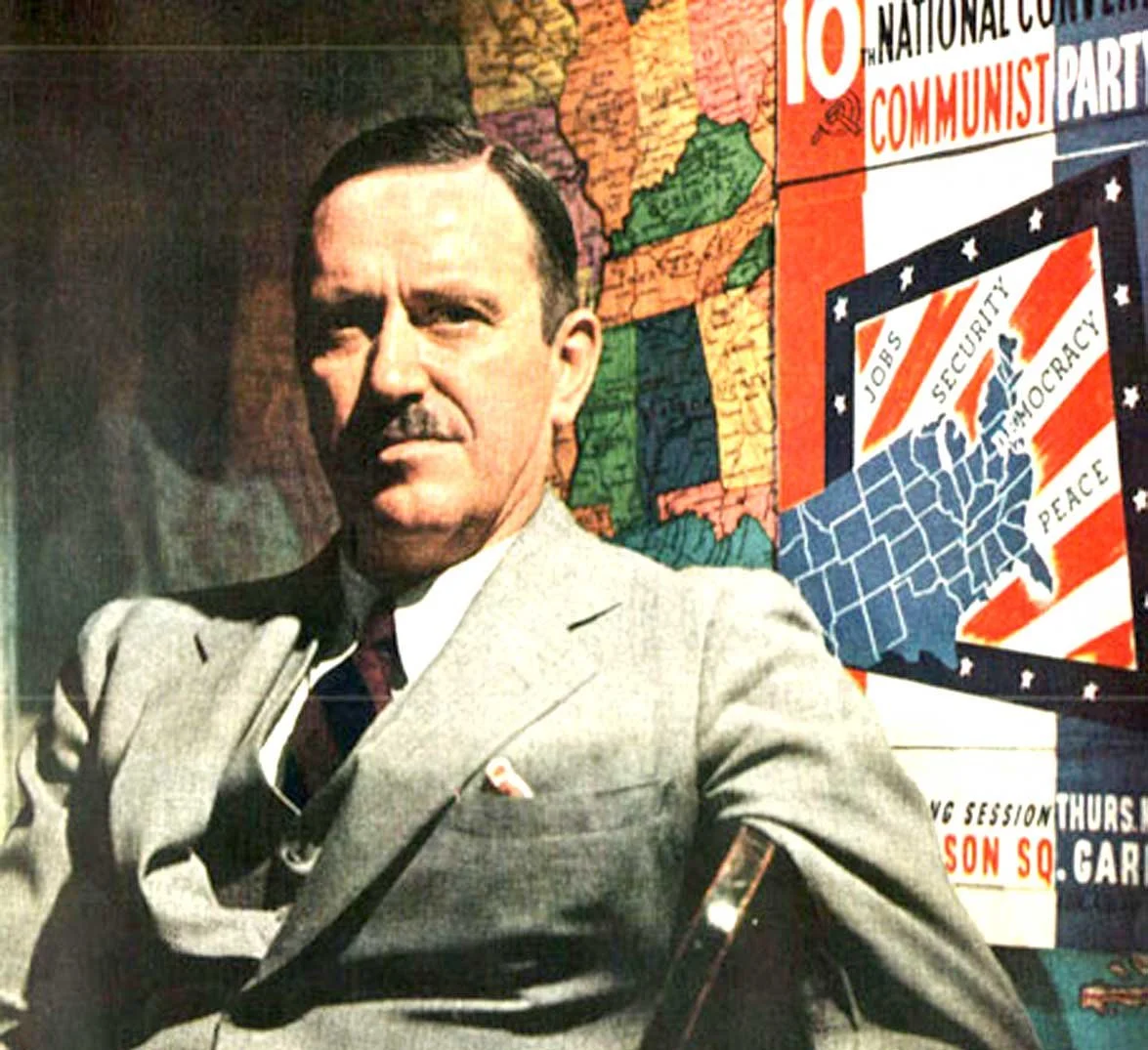
The 1932 presidential election reflected the CP's expanding influence. The CP nominated Foster for president and James W. Ford, one of the Party's leading Black organizers, for vice president. The Party appeared on the ballot in 40 states and received approximately 100,000 votes. The years 1929–1932 marked the contentious pathway of the CP's formative period and maturation, as it overcame the major obstacles of factionalism and isolation. The campaigns of these years prepared the CP for its period of greatest influence during the labor upsurge and Popular Front era of the 1930s, as well as the rise of Earl Browder as the Party's leader. The CP had finally taken steps to overcome the isolation that consistently plagued its earlier years.
SUMMARY OF CONCLUSIONS
It is necessary to examine the founding of the CPUSA, tracing its origins back to 1919, in order to properly appreciate its historical achievements and assess its role in the class struggle since its formation. In this way, those forces that have grouped around the need to reorganize the Communist Party in the US can draw useful conclusions from this experience for today's struggles, at a time when generalized imperialist war is looming, and the immediate task of our era is to unite the social forces capable of overthrowing this exploitative system.
These same forces must also distinguish themselves from those who distance themselves from our history. Rather than rejecting or ignoring it, we seek to reclaim the history of the communist movement in our country in all its complexity, reckon with its achievements and shortcomings, and place it in the service of intervening in the workers' and people's movements. In this sense, the study of our history is not merely an academic exercise but a vital element in the development of the Communist Party, making our activity more incisive, more effective, and better equipped to meet the tasks of the present. The study of our history is therefore a process of elevating our conscious activity to new heights.
The history of the CPUSA must be studied in conjunction with the Communist International, its Congresses, and its Theses. Only in this way can we fully understand the development of the serious weaknesses that emerged over the years and ultimately culminated in Browderism—that counter-revolutionary opportunist trend whose practical result was peace with our class enemy and the renunciation of our historic objective through the liquidation of the Party. It also allows us to understand the process of mutation of the CPUSA that exists today as a shell of its former self.
This history demonstrates that Browderism neither appeared from thin air nor represented a historical anomaly. Rather, it was a thread that can be traced back to the Party's very foundations. It was, in other words, the abscess of opportunism that eventually burst. The watering down of the organizational principles of the Party gradually transformed mistakes concerning those principles into a deviation and, ultimately, into a political current. In the history of the CPUSA, nearly every expression of opportunism grew on the basis of factionalism. It is therefore our duty to trace the roots of this opportunism, not as an exercise in curiosity, but as a practical necessity, to ensure that it does not once again lead to the loss of the ideological and political independence of the Party. Only by drawing these lessons can the future Party avoid repeating the errors that transformed the Communist Party in the US from the vanguard of the working class into an organization that abandoned its historic mission.
PART II: Browder’s Theory and Consequences
FOUNDATIONS OF A WORLDVIEW
Dialectical materialism is the world outlook of the working class, the revolutionary class at this moment in history wherein capitalism has given way to its own end. It is at once a theory and a method: as a theory, it adopts definite positions on the nature of reality; as a method, it provides a framework for analyzing and interpreting that reality.
What are the fundamental positions of dialectical materialism? To establish this, we must contrast the opposing point of view. Idealism, in all its varied forms, is the opposite of dialectical materialism. The term encompasses hundreds of philosophies unified by the notion that spirit, or idea, exists in some form of separation from material reality, and that the universe requires an outside creator or creative force to exist.
In Plato we find a systematized idealism. All objects we perceive with our senses (trees, good, evil, beauty, anger, democracy) are "shadows" of a higher realm of eternally unchanging reality: the Realm of Forms. A given tree is an imperfect copy of the eternal Form of "Treeness," which exists separate from the space and time we inhabit. The Upanishads, older still, present all of reality as the manifestation of an eternal, unchanging, undifferentiated spiritual foundation, Brahman, behind the world our senses experience (maya). Though separated by miles and years, both arrive at the same conclusion: matter is secondary to idea.
Thus, all of world philosophy divides into idealism or materialism. For the idealist, reality is the idea or spirit manifesting, matter is downstream of spirit. For the materialist, matter exists as an objective reality independent of our subjective experience: if a tree falls in the forest and no one is there to hear it, it nonetheless makes a sound. Matter is primary; mind is secondary, a complex product that emerges from material reality as a flower buds from a tree.
For dialectical materialism, matter is all that is and has ever been; no external force is required for the world to come into being, and there is no separate realm our senses grasp at but never reach. There is no eternal Form of a tree, chair, beauty, or democracy. This does not mean that trees, chairs, good and evil are not real; they emerge from (never apart from) the development of material reality. Reality is objective, unified, and knowable.
This contrast concerns ontology: what reality fundamentally is. But dialectical materialism is also a method, and in this respect its opposite is metaphysics: the approach that treats things as fixed, isolated, and static rather than in motion, interconnection, and unceasing development. A thinker can be a materialist in their concept of reality and yet reason metaphysically, treating matter as inert rather than self-moving and qualitatively developing. The following discussion of motion and development delineates the dialectical method from the metaphysical.
Dialectics recognizes reality as forever existing in motion. Engels states: "Motion is the mode of existence of matter." No part of our universe is ever not in motion. The natural sciences furnish evidence: absolute zero (the theoretically coldest temperature, where energy and entropy reach their minimum) cannot be reached. Motion requires no external force to begin; it always is and has been, so material reality is driven by self-motion.
Dialectics views all of reality as in permanent development. Nothing rests; there are no "final and ultimate" truths waiting to be discovered. There is no eternal idea of democracy and freedom that existed before the first master subjected the first slave. This does not mean that democracy, freedom, good and evil, or trees are not real; they emerge from reality in the course of its development.
As the working class's world outlook, it is our theory and method for not only analyzing the world but changing it. Without a solid grasp of it and consistent use and refining of the method, we will fail to make a revolution.
BROWDERISM
Earl Browder, General Secretary of the Communist Party of the United States of America from 1932 to 1945, and the CPUSA broadly, failed to grasp and apply dialectical materialism. The consequences of this failure were the decades-long setback of the communist movement in the USA and beyond. It is our task now to reckon with the failure, understand why this happened, and chart steps forward with this analysis in mind.
Before we move forward in doing so, we must resist frameworks and assumptions that limit the scope of our conclusions. First of all, Browder was but one individual amongst millions in the working class movement. His ideas did originate in his consciousness alone but arose from the political-economic conditions around him. That he took these erroneous ideas and advocated them to the extent he did is his great sin. Second, we must resist a “fall-from-grace” perspective that assumes as a starting point that the strategies and policies of the CPUSA and the communist movement at the time were valid and good by default until Browder and Browderism arrived and ruined a “good thing”. With this in mind, we begin our exposition of General Secretary Earl Browder’s metaphysics and theoretical errors. We pull primarily from his works Victory and After (1942) and Teheran: Our Path in War and Peace (1944).
In his fatal work, Teheran: Our Path in War and Peace, Browder adopts the tone and perspective of a State Department spokesperson. The work reads much more as a think-tank policy paper than a communist political work. Having shed any semblance of a revolutionary outlook, the concrete steps Browder advocates in Teheran amount to perhaps the gravest political mistake of the US communist movement in the 20th century: the dissolution of the CPUSA in 1944. The Tehran agreement reached at the end of 1943 between the Allied Powers (the UK, USA, and USSR) resulted in the agreement to open a second front against the Axis powers in the West.
Throughout his work Tehran, Browder elaborates a series of positions and proposals alien to the working class and its struggle for socialism-communism. He proposes a Wage Board between labor and management, classifies “friends and enemies” based on their orientation to the Tehran agreement, advocates that Marxists defend “free enterprise”, states that Americans are “ill-prepared” for socialism, and ultimately proposes that the CPUSA dissolve itself into a political association.
Taken individually, each of Browder’s proposals is a full-blown betrayal of the workers’ revolutionary movement. The interest of the workers, socialism-communism, is subordinated to Browder’s strategic objective of folding the American communist movement into the Roosevelt coalition, into the Tehran concord. Browder sees the agreement reached by the Allied Powers as the start of a new era wherein the interests of the workers and capitalists converge. He characterizes peace and unity in the construction of the post-war order as the interest of both the capitalists and the workers. His outlook and proposals all emanate from a total lack of understanding of the dialectical materialist worldview. Ideas such as peace and democracy are essentialized as immortal forms, devoid of their historical, social, and class content. Each of the positions in Browder’s work is therefore not an isolated, one-by-one deviation, but an internally rotten system of thought based on metaphysical, idealist conceptions of history and the entire class struggle. Reckoning with Browder, his origins, and support within the CPUSA is required for the US communist movement to move forward today, lest we risk repeating the same errors as Browder in essence if not in form.
History (as we have so far known it) is part of this reality, emerging from the complex social life of human beings. The contradictions of class society have driven history from one mode of production to the next, in a sequence of successive developments. At the heart of capitalism is the contradiction between social production and private appropriation. Under the capitalist mode of production, in contrast to previous modes of production, production necessarily acquires a social form wherein masses of people are brought into the interconnected and massive commodity production process from every stratum of the old society and from every corner of the world. Imagine how many thousands of people across the world are involved in the process of making a single shirt, a truck, an apartment building, a barrel of oil, and any other good or service one can imagine.
Never before in history was so much of society knit together to produce all of society’s goods and services. However, despite this social form, the value created in this process is appropriated privately. A thin minority, a class of people within society, decides what, when, where, how, and who produces everything for society. This here is the contradiction that drives the development of capitalism: social production versus private appropriation. This contradiction governs every aspect of our lives: the payment plans offered on fast food purchases, the price of groceries, the interest rates on student loans, the wages you take home, the price we pay to deliver a child at a hospital, how much of your money is taxed by the state, which wars are fought and against who, and all the rest. Within this system then emerge two sides, two classes: the workers and the capitalists, the exploited and the exploiters. The workers produce; the capitalists appropriate the surplus they produce in the form of profits, of ever-growing piles of capital built on the backs of the workers. At the root of capitalism then is an irreconcilable contradiction between these two classes. By the very logic of the system itself, between the exploiters and exploited there can be no peace, no arrangement in which the exploiters are not living off the labor of the exploited. The dialectical materialist worldview reveals this inescapable fact.
For Browder, who abandoned the side of the workers, the contradiction between labor and capital appears as nothing more than a circumstantial inconvenience. This marauder advances his chicanery in Tehran by proposing a “Wage Board” that would implement measures to manage the level of wages in the post-war era. As a manifestation of hallowed unity, Browder recommends that this Wage Board be composed of a “reasonable cooperation of management and organized labor”. Such an arrangement between labor and capital that would see the coordinated exploitation of labor flies against the essential contradiction of capitalism revealed by dialectical materialism. There can be no such peace, no such coordination in the form of a “Wage Board” or any other collaboration in which workers are freed from a condition of servitude. So long as workers must sell their labor—no matter the specific price—they remain at the mercy and behest of capital. This relationship, this dialectical contradiction, is invisible to Browder. Instead, “peace” and “prosperity” (and there can be no peace for workers subjected to exploitative relations) bulldoze any form of confrontation between the power of workers and the power of capital. Capital never relents on its subjugation of the workers; thus any compromise between these irreconcilable camps amounts to a surrender of the oppressed to their own shackles.
An understanding of contradiction as the universal engine of motion, of development, reveals the constant clash between these social forces. With this understanding, a revolutionary organization and its members, dedicated to the liberation of the workers, would not arrive at a proposal such as Browder’s Wage Board.
Browder’s analysis of the situation around the Tehran agreement reveals yet further the poverty of his worldview. Comrade General Secretary Browder displays his revolutionary ideological leadership with his proposed assessment of the Tehran concord:
“We can take it at its face value(!!), and then try to understand all the far-reaching consequences that must follow. Or we can decline to accept it at face value; we can begin to make reservations of one or another kind, in which case also we must try to understand the far-reaching consequences of the opposite.”
What class forces are at play here? Is the will of the workers or the will of capital reflected in the concord, and how? These questions are of no interest to Browder. Instead, analysis begins and ends at the geopolitical level. This surface-level analysis rests on a consideration of the political level first and the economic secondary. Browder flips historical materialism on its head, with economic changes and the policies of the communists downstream from momentary political situations. This orientation is stated plainly:
“There is only one guarantee for the achievement of the Teheran perspectives. That is a nation mobilized and organized in support of a system of detailed policies inspired and dominated by the Teheran objective and spirit.”
Class position, relations of production—these factors are assessed in relation to the foregone conclusion that the Tehran peace represents unto itself an essentially positive development. War between the capitalists, the Soviets’ role in the unfolding of history, are colored by eternal, de-classed notions of peace. Development in matters global and domestic, for Browder, is driven by the “vision and understanding” of men.
In this framework, the governments involved represent the wills of beneficent emissaries of peace-loving countries. These states are not representatives of their ruling class. Instead, they are only seen as diplomats negotiating the shape of a beautiful, prosperous new world. The class character of the states involved evaporates in the muddied mist of Browder’s enlightened clairvoyance. Without a razor-sharp understanding of the state and its class-based essence, all strategy for the class struggle devolves into exactly what Browder proposes in his work. Classes are treated by Browder as discrete categories, divorced from their historicity, interconnection, and development. There are workers, and there are capitalists and the state somewhere in the picture, for Browder. What drives each class in this picture is their moral conviction, attitude, and “vision” instead of the material interests that arise from their position in production, in the political-economic system. We see then for Browder that causality is inverted from material forces to the ideas of single individuals, from Churchill, Roosevelt, and Stalin to the venerated “men of vision”.
Class differences having been trivialized, individual motives divorced from the entire political economic system that creates them, the class character of the state is now for Browder wholly dissolved. For the revolutionary, the state stands as the ultimate crystallization of class rule. To enforce, maintain, and administer a given mode of production, the dominant class by necessity establishes its power in the form of a state. It is beyond the scope of this work to review the development of the state through history. We will point to the past 200 years of history at nodal points that revealed in a stark manner the class character of the state. Following three years of intransigence from the Royal government, on 10 August 1792 French republican forces stormed King Louis XVI’s Tuileries Palace, defeating the Swiss guard and arresting the king, thus smashing the remaining political power of the ruling feudal class and establishing the French Republic, the rule of the French bourgeoisie. In the frigid air of 25 October 1917, the workers and soldiers of Petrograd were led by the Bolshevik Party in seizing key points of government and utilities from the bourgeois Provisional Government and thus establishing working-class rule in Russia.
One class confronts another. The revolutionary class overthrows the ruling class, smashing the state and its machinery to reconstruct a new political-economic system. This history does not register for Browder, who advocates collaboration between the workers of the US and their exploiters. The strategy of a revolutionary party flows from the recognized possibility and necessity of revolution, where one class seizes power from the current ruling class. In Browder’s view, the seizure of power does not enter into the equation, therefore does not define the strategy, and therefore opens the path to such devastating conclusions as Browder’s defining recommendation: the dissolution of the Communist Party of the USA.
With the contest for state power written off, what need then for a vanguard force to organize the class forces needed to defeat the opposing class? There is no such need in the world of Browder. Therefore the necessity of the Communist Party evaporates and is replaced by an “Association”. The Communist Party is the highest form of working-class organization. The Party represents the consolidated ideological-political consciousness of the workers. History tasks the Party with leading the workers in their contest for power against capital. Dialectical materialism reveals this truth to us, and the course of events of the previous two centuries furnishes this conclusion with concrete proof of this state of affairs. The Party is not automatically the vanguard force, however; instead, the Party arises from the needs of the working class, from the realization that capitalism (generalized commodity production driven by the commodification of labor power itself, exploitation) cannot be ended without the overthrow of the capitalist class and its state. The Paris Commune demonstrated in 1871 the possibility of defeating the capitalists' overlords, but that organized leadership and the complete capture of the state are indispensable in maintaining this victory. The October Revolution demonstrated in 1917 that the Party can fulfill this historical task. The defeated German Revolution in 1918 to 1919 demonstrated that any other form of organization than the vanguard party of a new type (or, the Bolshevik form of organization) will fail the workers and leave open the path for capital to regroup and strike back at the workers in earnest. The working class and its communist leadership in the USA cannot but afford to expose the betrayal Browderism represents.
Earl Browder delivered his Teheran speech in the months prior to his proposal to dissolve the CPUSA. The ideological-political foundations of this betrayal of the working class are elaborated most explicitly by Browder in his works Victory and After and Teheran. To this day the revolutionary working class movement in the United States has yet to completely reckon with the ideological and practical consequences of this betrayal and the long, winding path the CPUSA, its leaders, and the movement took to arrive at the disastrous dissolution in 1944.
LIQUIDATION
In January 1944, with the Party’s membership having reached a peak of 80,000, the National Committee of the Communist Party USA sent a letter to the Party’s districts with the proposal to dissolve the Party into a political association. The Party’s districts endorsed this proposal over the following months. The National Committee then convened the Twelfth Convention of the CPUSA to consider the proposal. While opposition to the proposal came from Foster and Darcy, as stated by Foster in his letter to the National Committee, ultimately the leadership voted in favor of Browder’s proposal at the May 20 convention:
"I hereby move that the Communist Party of America be and hereby is dissolved and that a committee of three consisting of the Chairman, General Secretary, and Assistant Secretary of the Party, be authorized to take all necessary steps to liquidate its affairs and that such committee is further authorized to dispose of all its property and to turn over any surplus that may remain to any organization or organizations that in their opinion are devoted to our country's winning of the war in which it is presently engaged and in the achieving of a durable peace."
With the proposal adopted, the Communist Party of the United States dissolved itself. The delegation of now former National Committee members set about establishing the Communist Political Association in its preamble as "a non-party organization of Americans which, basing itself upon the working class, carries forward the traditions of Washington, Jefferson, Paine, Jackson, and Lincoln, under the changed conditions of modern industrial society… [and] adheres to the principles of scientific socialism, Marxism…”. This association devoted itself to upholding the institutions of capitalist power in the United States, going so far as to place in the preamble disciplinary measures (immediate expulsion) for any member or group within the Association that “conspires or acts to subvert, undermine, weaken, or overthrow any or all institutions of American democracy.”
Defense of the bourgeois state, the ultimate instrument of class rule over the working class, was thus sanctified as an idealized representative of the will of the people. The struggle of the working class for its freedom, for full lives liberated from exploitation, for control over their own collective and individual lives was altogether abandoned here. From the earliest days of the CPUSA, the seeds of this betrayal lay in its push for a Labor Party, the La Follette movement, and the popular front alliances of the 30s. Establishing the CPA over the grave of the CPUSA, in essence the abandonment of the class struggle itself, was a logical endpoint for this thread.
The Tehran concord was but the immediate pretext for this conclusion. Browder and the rest of the National Committee’s metaphysical orientation prohibited the development of a revolutionary line at this moment or prior. Browderism, the liquidation of the CPUSA, and the entire preamble of the CPA with its fatal sanctification of “American democracy” and its institutions were the practical results of the ideological poverty of the CPUSA.
It was only with the intervention of the international communist movement that this fatal error was remedied. Though the blow had been dealt (and the rot at the core persisted for the rest of the Party’s history), the CPUSA was reformed, the CPA was done away with, and Browder dissolved following the Duclos Letter. Jacques Duclos was a leader of the French Communist Party and member of the Comintern during the fateful years of WWII and Vichy France. In his April 1945 letter, On the Dissolution of the Communist Party of the U.S.A., Duclos traces Browder’s revisionism to the claim of a “peaceful coexistence” between capitalism and socialism that Browder had expounded at a speech prior to his Teheran speech. The letter quotes from Browder one of his more illuminating statements from his Bridgeport speech:
“If J.P. Morgan supports this coalition and goes down the line for it, I as a Communist am prepared to clasp his hand on that and join with him to realize it. Class divisions or political groupings have no significance now except as they reflect one side or the other of this issue.”
Duclos did not reserve his judgement to the individual figure of Browder, explicitly stating that Foster, even in his dissenting letter, did not openly oppose the proposed CPUSA dissolution. He concluded in his letter that the dissolution of the CPUSA was a liquidation of the independent political party of the US working class and that Browder’s line was a revision of Marxism expressed as class peace between labor and capital which is in practice a suppression of the class struggle.
The result of this letter in the CPA in 1945 was a shockwave. In the summer of 1945, between the receipt of Duclos’ letter in May and the calling of a 13th convention of the CPUSA in July, Browder was removed from leadership of the CPA, the CPA itself was disbanded, the CPUSA re-established, and Browder’s veneration of bourgeois democracy was repudiated. Thus, the grave mistake of the 1944 liquidation was undone. However, history proved this move to be too little, too late.
Duclos's letter, decisive as its intervention was, corrected the practical liquidation without diagnosing the ideological underpinning. Neither the Duclos Letter nor the subsequently reformed CPUSA asked why a General Secretary trained in the US communist movement for over two decades arrived at a metaphysics indistinguishable from US State Department positions. The philosophical basis, the deep-rooted ideological poverty of the CPUSA that made liquidation a logical output of a worldview, was never fully reckoned with. The Duclos Letter, the 13th Convention, and the expulsion of Browder rescued the Party's formal organization but did not ultimately reform the Party's philosophy.
BEYOND BROWDER
Browderism was not an aberration within the history of the US communist movement, nor were the essential conclusions and strategies of the CPUSA and Browder isolated to the USA. Indeed, the world communist movement before, during, and after the thirty-year crisis of imperialism (1914-1949) adopted many of the metaphysical views and resulting strategies. The CPUSA itself played a large role in the Communist International throughout its history. Contrary to bourgeois propaganda of the time, the ComIntern was not some force of malicious Soviet influence over free Americans through the CPUSA, but was a collective reflection of the world communist movement throughout its history.
The policy of alliances adopted by workers and communist parties in the 1920s through 40s, born of the existential threat of imperialist onslaught and the new fascist menace, metastasized into class collaborationist policies throughout the world communist movement. Browderism was but one of (and certainly one of the more extreme) the examples of this phenomenon. Many of these abscesses did not heal following the war. Khrushchevite revisionism of peaceful coexistence between the capitalist and socialist world, for example, represents a continuation of these policies. In too many cases, even if the symptoms were addressed, the root disease was not diagnosed.
In the Americas, we may examine the case of Cuba’s Popular socialist Party (PSP). The PSP under General Secretary Blas Roca Calderio entered a political alliance in support of President Fulgencio Batista (the one and only) due to his pro-labor union stances and, crucially, his pro-Allied position in World War II. This led the PSP to hitch the fate of Cuba’s working class to the butcher Batista (though his gravest offenses were yet to come). When the Cuban Revolution began in earnest with the attack on the Moncada Barracks on 26 July 1953, these Cuban communists denounced the attack as a “putsch”. This ultimately left the PSP-communists in a trailing position when the triumph of 1959 came about.
The Communist Party of Mexico (PCM) under Dionisio Encina and Lombardo Toledano followed the line of Browderism in the mid–1940s as well. With the Mexican Revolution having concluded in recent memory, the political-social forces consolidated within the Institutional Revolutionary Party (PRI). Encina and Toledano decided to adamantly support the PRI (the party that consolidated Mexico's post-revolutionary state apparatus and ruled uninterrupted from 1929 through 2000) government as a progressive force. Tailing the PRI eroded the political independence of the PCM over the course of the 20th century.
Across the Atlantic, many communist and workers’ parties of Europe followed a similar class collaborationist line. The French, Italian, and Spanish communist parties joined coalition governments with social democratic and liberal parties. Hand in hand with the ruling class, the communists joined in the management of capital and left the class struggles behind. Most of these parties did not reach Browder’s level of counter-revolutionary zeal by dissolving their parties. Regardless, they achieved the same result by surrendering the independent political position of the working class it was their historic duty to represent.
Few of the European cases were directly inspired by Browder, in contrast to the Latin American examples (of which a number were left unaddressed, such as the case of Venezuela). Nevertheless, the path of class collaboration and delay of the struggle for socialism, which was often euphemistically referred to as the “Soviet system”, developed into a widespread deviation amongst the world communist movement in the decades after WWII. Nowhere was an explicit class collaborationist policy as disastrous, however, as in the case of the People’s Republic of China.
The Chinese Revolution is a mammoth historical event and process. Beginning with student protests in May 1919 and the establishment of the Communist Party of China (CPC) in Shanghai in 1921, the revolutionary contest for power between the CPC and the nationalist Kuomintang would span three decades up to the end of the civil war and declaration of the People’s Republic of China in 1949. This revolution produced one of the most coherent theoretical distortions to the world communist movement in the twentieth century, laying the foundation for one of the greatest mistakes of the 20th century working-class struggle.
Mao Zedong's theory of New Democracy, elaborated principally in his 1940 work of the same name, sought to define the character of the Chinese Revolution and the stage of development through which China must pass before arriving at socialism. In its broad outlines, New Democracy argued that “semi-colonial”, “semi-feudal” China could not pass directly to socialism but must first complete a bourgeois-democratic revolution under the “joint leadership of the revolutionary classes", which Mao and the CPC of the time identified as the proletariat, the peasantry, the urban petty bourgeoisie, and the national bourgeoisie. This bloc of four “revolutionary” classes, united under Communist Party leadership, would construct a New Democratic state and economy. This state would be neither capitalist nor socialist, but a transitional form with its own internal logic and its own period of development before the socialist stage could begin, per Mao.
The parallel to Browder exists at the level of method, not organizational form, as the consequences for both deviations were class collaborationist policies. Browder dissolved the Communist Party, whereas Mao built and led his Party to seize state power in 1949. To collapse these two figures into simple equivalence on organizational grounds would be a mechanistic error. The parallel must be seen at the level of their metaphysical worldviews. Specifically, at the level of stagism, the harmonization of class interests within a multi-class bloc, and the systematic postponement of the irreconcilable contradiction between the proletariat and the bourgeoisie to an indefinite future. Both Browder and Mao justify their respective policies with their analysis of the present political situation. Both Browder and Mao avoid engagement with the fundamental laws of capitalist development and the historicity of their political situation. Dialectical materialism, the Marxist method, allows us to read a given political situation (for Browder, the end of WWII; for Mao, Japanese occupation of China) not as an isolated phenomenon, but as an episode in the broader unfolding of history. Both Browder and Mao divorce their political situations from the development of capitalism as a political-economic system with a given set of laws of motion. This led both Browder and Mao to formalize policies based on a surface-level, metaphysical conception of concepts such as peace, imperialism, and democracy.
Between Browder and Mao, the fundamental parallel is the elevation of a tactical multi-class alliance into an enduring stage with its own theorized internal harmony. For Browder, the Tehran concord represented a convergence of the interests of labor and capital around the tasks of winning the war and constructing a stable postwar prosperity. For Mao, New Democracy represented the convergence of the interests of the proletariat, peasantry, petty bourgeoisie, and national bourgeoisie around the tasks of completing the anti-feudal, anti-imperialist revolution. In both cases, what began as a tactical recognition of the need for broad alliances under specific political, historical conditions concretized non-antagonistic policies between labor and capital. Browder was explicit: "class divisions or political groupings have no significance now except as they reflect one side or the other" of the Tehran issue. Mao was more sophisticated, maintaining the language of proletarian leadership and developing a system of thought (in On Contradiction, On Practice, and more), but the content of the “national” bourgeoisie as a class whose interests can be harmonized with those of the proletariat within a shared state over an extended historical period represents the same theoretical and strategic errors as Browder: peace between labor and capital. The contradiction between the proletariat and the bourgeoisie, which dialectical materialism identifies as irreconcilable under any form of commodity production, is treated as manageable, containable, productive of unity rather than of a fundamental dialectical contradiction.
Both Browder and the New Democracy framework share the methodological error of positing an intermediate stage – separated by magic from the development of capitalism – that must be completed before the socialist revolution can be placed on the agenda. For Browder, this stage is the postwar period of national unity and capitalist reconstruction, measured in "a long period of years." For Mao’s New Democracy, the stage is the democratic revolution itself, measured in the entire historical period of China's transition from “semi-colonial”, “semi-feudal” conditions to the preconditions of socialist construction. In both cases, the practical result is the same: the postponement of the conflict between labor and capital, the deferral of the socialist objective, and the construction of a theoretical framework in which raising the question of that antagonism prematurely is itself characterized as an error: sectarian, adventurist, dogmatic, or divorced from concrete conditions. Browder made this argument explicitly against anyone who raised socialism during the war.
A third parallel is the geopolitical rather than political-economic-based analysis of the international situation that Browder and Mao adopt. As demonstrated throughout this work, Browder's analysis of Tehran begins at the level of apparently class-neutral states, governments, and diplomatic agreements rather than at the level of class forces and their material interests. The class character of the Roosevelt administration, the Churchill government, and the postwar international order they were constructing is invisible to Browder, as he had already theoretically dissolved the class character of the state in favor of a framework of geopolitical alignment amongst de-classed states. The Maoist trajectory, particularly after the Sino-Soviet split of the early 1960s and its full elaboration in the Three Worlds Theory, reproduces this method with a different geopolitical situation. The Three Worlds Theory, which divided the world into a first world of superpowers (the US and USSR), a second world of intermediate powers, and a third world of developing nations, replaced class analysis with a geopolitical schema in which the “principal” contradiction was not between capital and labor (again!) but between hegemonic superpowers and the nations resisting their domination. It is not merely that Mao misidentified which contradiction was “principal” in a specific moment. The category of a 'principal contradiction' reduces what is in reality a complex interpenetrating totality of contradictions to a hierarchy of contradictions that may be reordered based on “circumstances”. This is a mechanical, undialectical operation that maintains Mao and Browder ultimately in the same theoretical camp and thus with parallel strategic errors.
The practical consequence of Mao’s line mirrored Browder's framework: tactical alliance with one imperialist power (the United States) against the designated greater threat (the USSR as "social imperialism") justified by a geopolitical designation rather than an analysis of the political-economic developments in the capitalist-imperialist system. Such an “anti-revisionism” that arrives at alliance with imperialism has not overcome revisionism, but has reproduced revisionism under a new flag.
The necessary and decisive distinction, however, is this: the CPUSA's correction came swiftly, comparatively. The Duclos Letter arrived in April 1945; by July of that year the CPA had been disbanded, the CPUSA reconstituted, and Browder expelled. The correction was disciplinary and organizational. However, the correction remained incomplete, as this work has argued, because it did not diagnose the ideological roots of the deviation. Nonetheless, the correction was accomplished within the lifetime of the error. The Maoist version of the same essential errors became constitutive of a state's foundational ideology. New Democracy became the theoretical framework of a state governing hundreds of millions of people, embedded in the CPC’s self-understanding, reproduced in its educational institutions, and defended against internal criticism through the mechanisms of democratic centralism that should have enabled its correction. The Three Worlds Theory was not a tactical pamphlet but a position advanced by the Chinese state at the United Nations, shaping the alignment of dozens of parties and governments across the world communist movement. This is why Browder and his bastards are not a closed historical chapter but a live theoretical danger. These errors have proven capable of constituting entire state ideologies and generating entire theoretical traditions that persist long after the concrete historical conditions that initially produced them have passed, both in the many forms of popular front strategies and Maoist policies for many large parties throughout the world.
The working class and its communist leadership cannot afford to treat these errors as dead curiosities of the past. They are the active forms that opportunism takes when the pressure of concrete historical conditions (war, fascism, imperialist invasion) create the openings to elevate tactical alliances into enduring strategies, to smooth over the inescapable contradiction at the heart of capitalism between labor and capital.
CONCLUSION
The history traced in this work from the factional struggles of the CPUSA's founding years through the elaboration of Browder's revisionism and its international echoes shows to us today that the mistakes made by those before us had consequences affecting millions of workers in their time and set the stage for our conditions today. Indeed, Browder and his bastards made history. It is our task today to analyze this history. This history of a political tendency, rooted in the objective pressures of capitalism-imperialism on the working-class movement, has reverberations and echoes in our own time. Browderism emerged from the accumulated weight of a decade of class-collaborationist drift, from the theoretical immaturity of a party that never developed the stomach to metabolize the lessons of the October Revolution and the organizational principles of the Party of a New Type, and from the genuine difficulty of maintaining a revolutionary line under conditions of fascist threat to the world communist movement. These objective conditions produced subjective errors.
These errors and their consequences — the dissolution of the Communist Party, the abandonment of the class struggle, the decades-long setback of the revolutionary movement in the United States and many other countries — were paid for by the working class in blood, time, organization, and in the possibility of victory in the 20th century.
The philosophical root of Browderism, as this work has argued, is the abandonment of dialectical materialism as both the theory and method of the communist party. Dialectical materialism furnishes the party with a clear vision and understanding, based in historical materialism, of the total antagonism between labor and capital. When the irreconcilable contradiction between labor and capital is obscured, the entire revolutionary strategy that flows from recognizing that contradiction crumbles to dust. When the class character of the state is dissolved into a framework of geopolitical alignment, the vanguard function of the communist party (to organize the working class for the seizure of power) becomes not only unnecessary but actively disruptive of the "unity" that has been elevated to a supreme strategic objective. When qualitative development is mistaken for quantitative change, when bourgeois state management of production is mistaken for socialism, when the Tehran agreement was theorized as a new era of historical development, then the compass of revolutionary strategy is smashed, and the party is left navigating by the coordinates of the ruling class's own ideological compass.
The Duclos Letter corrected the organizational expression of these errors. It did not correct the philosophical foundation from which they grew. That correction requires exactly what this work attempts: a systematic reckoning with the roots of the deviation, traced from their origins in the early CPUSA through their consolidation in Browderism and into their many manifestations throughout the international communist movement.
The task before the communist movement in the United States today is therefore not simply to avoid repeating Browder's specific conclusions (the dissolution of the party, the embrace of free enterprise, the subordination of class struggle to “unity”) but even deeper: to build the philosophical and organizational foundations that make those conclusions impossible to repeat.
This necessitates the consistent application of dialectical and historical materialism to every question of strategy and tactics; the maintenance of the communist party's organizational independence from all bourgeois and petite bourgeois political formations regardless of how “progressive” they dress themselves; the refusal to elevate any tactical alliance into a convergence of class interests; and the ceaseless, theoretically rigorous development of the subjective factor, the communist party itself, as the decisive instrument through which the working class will organize its historic contest for power.
Browderism demonstrated what happens when that instrument, the communist party, is abandoned. The October Revolution demonstrated what becomes possible when the party is built with discipline, ideological-political clarity, and an unwavering commitment to the liberation of the working class from capitalist exploitation.
Between these two historical poles, the path of the communist movement in the United States is now being built. This is the task of our generation.