
Work and Travel Program: Opportunity or Exploitation?
When my friend told me his brother was paying $160 a week to live in a house with 31 people and only three bathrooms, I was shocked but not surprised. His brother came to the United States through the J-1 Work and Travel program, which is promoted as a cultural exchange opportunity for international students. In reality, many students end up in overcrowded housing, unstable jobs, and conditions that barely allow them to recover the money they spent to come.
His story reminded me of my own experience on the J-1 program. I lived with 11 other people, with four people packed into each room on bunk beds and only two bathrooms shared among all of us. The landlord restricted basic things most people would consider normal: we were not allowed to use the dishwasher, and the laundry room was open only two days a week. For twelve people working long hours and relying on just a few work uniforms, two days of laundry access was simply inadequate.
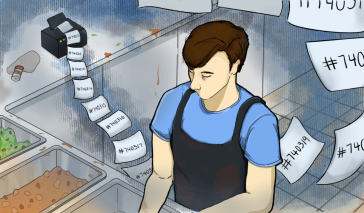
I worked at a local sandwich chain that hired many J-1 students. Because I arrived early, I secured a position, but many students who arrived later were turned away once enough workers had been hired. They then had to search for another J-1-approved employer willing to complete the required paperwork, or else return home. Even those of us who got the job were scheduled only during peak hours and sent home once business slowed down, leaving most people with just a few hours of work each day. I also discovered that my paycheck was missing ten hours of work after someone altered my recorded hours, claiming I had forgotten to clock out. Because I kept my clock-out receipts, I was able to prove otherwise and recover my lost wages. It made me
wonder how many students lost wages without noticing or lacked the proof needed to fight back. Furthermore, the company suddenly closed the location and informed employees by text that same morning, giving them no advance notice and leaving all workers without jobs.
Students from Thailand often spend between 120,000–200,000 baht ($3,300–$5,500 USD) on program fees, visa costs, insurance, flights, and housing before even arriving in the United States. Because of these enormous upfront costs, many students feel pressured to work as much as possible just to break even. To cover my expenses and still hope to travel afterward, I worked three jobs simultaneously while earning only around $10 an hour.
Insurance was another scam within the program. Health insurance is mandatory for all J-1 participants (a gift to capital), yet many students discover how little protection they actually have once something goes wrong. One of my friends crashed her bicycle into a pole and was taken to the hospital in an ambulance. After waiting hours without seeing a doctor, she decided to leave and was later charged close to $3,000 for the ambulance ride because insurance refused to cover it.
Another friend suffered an even worse accident when her pinky finger was cut in a vegetable cutter at work. After waiting hours at one hospital, she was transferred to another because the first could not reattach the finger. By the time surgeons attempted to reconnect it, nearly eight hours had passed and the tissue had already died. She permanently lost her pinky. Insurance later denied coverage because the injury happened at her second job rather than the job tied to her visa sponsorship. Beyond the physical trauma, the financial cost was devastating.
The J-1 Work and Travel program presents itself as cultural exchange and an opportunity for students to experience life in the United States. In reality, it is a business built on temporary student labor where multiple industries profit while student workers carry most of the risk. Agencies collect large fees before students even arrive. Employers gain a disposable workforce willing to accept unstable hours, low wages, and poor conditions during peak tourist seasons. Some employers also take advantage of the fact that students have limited alternatives, depend on their jobs to recover their costs, and will return home within a few months, making them less likely to challenge mistreatment or pursue legal action. Meanwhile, landlords profit from overcrowded housing and exploitative rents, and insurance companies, as seen in these cases, continue collecting mandatory payments while denying coverage when students need help most.
These are not isolated incidents or simply a few “bad employers.” This exploitation is caused by capitalism whose main goal is profit maximization. The exploitation of J-1 students is only a small reflection of how the working class is treated. Workers are expected to sacrifice their time, health, and stability so businesses can continue increasing profits. Working class exploitation will never end under capitalism because profit always matters more than workers’ lives and welfare.